<?xml version="1.0" encoding="utf-8"?><feed xmlns="http://www.w3.org/2005/Atom" ><generator uri="https://jekyllrb.com/" version="3.10.0">Jekyll</generator><link href="https://imscientist.dev/feed.xml" rel="self" type="application/atom+xml" /><link href="https://imscientist.dev/" rel="alternate" type="text/html" /><updated>2026-05-09T15:30:50+00:00</updated><id>https://imscientist.dev/feed.xml</id><title type="html">I ♥ DS</title><subtitle>Personal thoughts, ideas, and writing.</subtitle><author><name>ImScientist</name></author><entry><title type="html">Probabilistic Forecasting with LightGBM and Dask</title><link href="https://imscientist.dev/2025/11/30/probabilistic-prediction-lightgbm/" rel="alternate" type="text/html" title="Probabilistic Forecasting with LightGBM and Dask" /><published>2025-11-30T00:00:00+00:00</published><updated>2025-11-30T00:00:00+00:00</updated><id>https://imscientist.dev/2025/11/30/probabilistic-prediction-lightgbm</id><content type="html" xml:base="https://imscientist.dev/2025/11/30/probabilistic-prediction-lightgbm/"><![CDATA[<p>
    In this post we train LightGBM to make probabilistic predictions of a continuous target variable. We cover aspects
    about the model architecture, model training and evaluation that are specific for probabilistic models: in
    particular, we explain the reasoning behind the choice of the initial score, custom loss, and objective function.
    The model will be trained on a large dataset using custom loss and objective functions. To achieve this, we will use
    LightGBM-Dask on a Kubernetes cluster running in Google Cloud. In the provided
    <a href="https://github.com/ImScientist/probabilistic-forecasting-travel-time-lightgbm">Github repository</a>,
    you can find the
    code to reproduce all steps: from the creation of the required infrastructure to model training and evaluation.
</p>

<h3>Table of Contents</h3>
<p>
<ol class="toc-list">
    <li>
        <a href="#introduction">
            <span class="title">Introduction</span>
        </a>
    </li>
    <li>
        <a href="#model_architecture">
            <span class="title">Model Architecture</span>
        </a>
        <ul>
            <li><a href="#model_architecture_1">2.1 Calculating Raw Scores</a></li>
            <li><a href="#model_architecture_2">2.2 Mapping Raw Scores to Distribution Parameters</a></li>
        </ul>
    </li>
    <li>
        <a href="#model_training">
            <span class="title">Model training</span>
        </a>
        <ul>
            <li><a href="#model_training_1">3.1 Loss function</a></li>
            <li><a href="#model_training_2">3.2 Estimating Initial Scores</a></li>
            <li><a href="#model_training_3">3.3 Growing Trees: The Objective Function</a></li>
            <li><a href="#model_training_4">3.4 Taylor Approximation of the loss function</a></li>
        </ul>
    </li>
    <li>
        <a href="#model_evaluation">
            <span class="title">Model evaluation</span>
        </a>
        <ul>
            <li><a href="#model_evaluation_1">4.1 Calibration plot</a></li>
            <li><a href="#model_evaluation_2">4.2 Probability integral transform histogram</a></li>
            <li><a href="#model_evaluation_3">4.3 Relative standard deviation histogram</a></li>
            <li><a href="#model_evaluation_4">4.4 Continuous ranked probability score (CRPS)</a></li>
        </ul>
    </li>
    <li>
        <a href="#dask">
            <span class="title">Practical Aspects of Model Training with Dask</span>
        </a>
        <ul>
            <li><a href="#dask_1">5.1 Why Dask for Distributed LightGBM Training?</a></li>
            <li><a href="#dask_2">5.2 Cloud Infrastructure Setup on Google Cloud Platform</a></li>
            <li><a href="#dask_3">5.3 Dask Deployment on Kubernetes</a></li>
        </ul>
    </li>
    <li>
        <a href="#references">
            <span class="title">References</span>
        </a>
    </li>

</ol>
</p>


<h3 id="introduction">1. Introduction</h3>

<p>
    In many real-world scenarios, we need more than just a single predicted value - we also need to quantify the
    uncertainty around it. For instance, when predicting a 30-minute trip, we might want to know: "What's the
    probability that this trip will last between 25 and 35 minutes?" Is it 50%? 80%? 95%? This information is crucial
    for decision-making.
</p>

<p>
    One powerful way to capture this uncertainty for regression problems is to predict an entire probability
    distribution $\rho$ rather than a single point. The distribution tells us where we expect the forecasted variable to
    lie,
    and how certain we are about this expectation. A narrow distribution indicates high certainty; a wide distribution
    indicates more uncertainty. In this post, we use LightGBM to predict the parameters that fully describe such a
    distribution.
</p>

<h5>Problem Setup: Predicting Trip Travel Times</h5>

<p>
    To make the discussion concrete, we focus on the problem of predicting trip travel times. Since travel times should
    be positive, we choose the <b>Gamma($\alpha$, $\beta$) distribution</b> to model the uncertainty in our predictions.
    Our task is to predict both distribution parameters $\alpha$ and $\beta$ (that are positive, as well) as functions
    of the input features $x$: e.g., distance, time of day, weather conditions, etc.
</p>

<h3 id="model_architecture">2. Model Architecture: From Inputs to Distribution Parameters</h3>

<p>
    Our model transforms input features $x$ into distribution parameters $\alpha$ and $\beta$ through a two-step
    process. First, the
    gradient boosting model produces two raw scores $a_1(x)$ and $a_2(x)$ for each input $x$. These raw scores are then
    transformed into the positive distribution parameters $\alpha(x)$ and $\beta(x)$ using a mapping function $g$.
    Below, we examine each step in detail.
</p>

<h5 id="model_architecture_1">2.1 Calculating Raw Scores</h5>

<p>
    For a single input $x$, the gradient boosting algorithm computes raw scores using the standard iterative formula:
</p>

\begin{align}
\label{eq:eq001}
a^{[T]}_j(x) & = a^0_j + \sum^{T}_{t=1} f^{t}_{j}(x)   \hspace{10.0mm} (j=1,2)
\end{align}

<p>
    The term on the left-hand side is the raw score for output $j$ after $T$ training iterations. The first term on the
    right-hand side $(a^0_j)$ is the initial score (constant baseline) for output $j$, estimated before any trees are
    grown. The $f^t_j$ refer to the contribution from the $t$-th tree to output $j$. In our case,
    $j \in \{1, 2 \}$ because we need two outputs: one will encode the mean value and the other - the rate parameter of
    the Gamma distribution.
</p>

<p>
    Applying this formula to all $N$ points of the training dataset, gives us $2N$ outputs in total. It's convenient to
    organize these outputs into a $N \times 2$ matrix $A$, where each row corresponds to one data point, and the
    first/second column contains all $a_1$, $a_2$ values, respectively. Using matrix notation, the equation becomes:
</p>

\begin{align}
\label{eq:lgbm_def_matrix}
A^{[T]}(x) & = A^{0} + \sum^{T}_{t=1} A^{t}(x) \hspace{10.0mm} A^{t} \in R^{N \times 2}
\end{align}

<p>
    The term on the left-hand side refers to the matrix of raw scores after $T$ iterations. The first, second column of
    the initial score $A^0$, is equal to $a^0_1$ and $a^0_2$, respectively. $A^t$ holds the outputs from the $t$-th pair
    of trees. Row $i$ $(i=1 \ldots N)$ contains the predictions for the $i$-th data point $x_i$. We'll use this matrix
    notation when deriving the objective function later.
</p>


<h5 id="model_architecture_2">2.2 Mapping Raw Scores to Distribution Parameters</h5>

<p>
    The raw scores $a_1(x)$ and $a_2(x)$ can be any real numbers (positive or negative). However, the Gamma distribution
    parameters $\alpha$ and $\beta$ must be strictly positive. Therefore, we apply a transformation $g$ that maps real
    numbers to positive numbers:
</p>


\begin{align}
\alpha (x) & =  {\rm softplus}(a_1 (x)) \cdot {\rm softplus}(a_2(x)) \nonumber \\
\label{eq:g_map}
\beta (x) & = {\rm softplus}(a_2(x))
\end{align}

where the softplus is defined as:

\begin{align*}
{\rm softplus}(x) & = \log \left(1 + e^x \right)
\end{align*}

<p>
    The ${\rm softplus}$ function is a smooth approximation of the ReLU function that ensures positive outputs while
    remaining differentiable everywhere which is essential for gradient-based optimization.
</p>

<p>
    The map defined in \eqref{eq:g_map} might seem like an arbitrary choice, but it has important advantages:
</p>

<ul class="toc-list">
    <li>
        Interpretable decomposition: $ {\rm softplus}(a_1) = \alpha / \beta$ represents the mean of the Gamma
        distribution, and $ {\rm softplus}(a_2) = \beta$ represents the rate parameter (inversely related to the scale
        parameter).
    </li>
    <br>
    <li>
        Separation of roles: The first tree $f_1$ learns patterns related to the average travel time, while the second
        tree $f_2$ learns patterns related to variability. This separation helps the model learn more efficiently.
    </li>
</ul>

<p>
    Alternative mappings are possible: for example, $\alpha = {\rm softplus} (a_1)$, $\beta = {\rm softplus} (a_2)$, but
    they don't offer the same interpretability and may lead to slower convergence during training.
</p>


<h3 id="model_training">3. Model training</h3>

<h5 id="model_training_1">3.1 Loss Function</h5>

<p>
    To train our model, we need to define what "good predictions" mean mathematically. Instead of comparing the observed
    values $\{ y_i \}$ with the model point-predictions we have to compare them with predicted distributions. There are
    several loss-functions (aka. scoring rules) that can quantify how good is a predicted probability distribution
    compared to an observation. Here, we will use the negative log-likelihood of the Gamma distribution:
</p>

\begin{align}
\label{eq:loss_fn}
L & = \sum^{N}_{i=1} l_i = \sum^{N}_{i=1} - \log\left[ \rho \left(y_i | \alpha(x_i), \beta(x_i) \right) \right]
\end{align}

<p>
    where $l_i$ refers to the contribution to the loss from data point $i$. The Gamma distribution evaluated at the
    observed trip travel time $y_i$ is denoted by $\rho (y_i | \alpha(x_i), \beta(x_i) )$. Note: In practice, you might
    normalize this loss by dividing by $N$, but we omit this for notational simplicity.
</p>


<h5 id="model_training_2">3.2 Estimating Initial Scores</h5>


<p>
    Before growing any trees, we need to establish baseline predictions: the initial scores $a^0_1$ and $a^0_2$. These
    are feature-independent constants that provide a reasonable starting point for the iterative learning process. To
    find them we have to do the following steps:
</p>

<ul class="toc-list">
    <li>
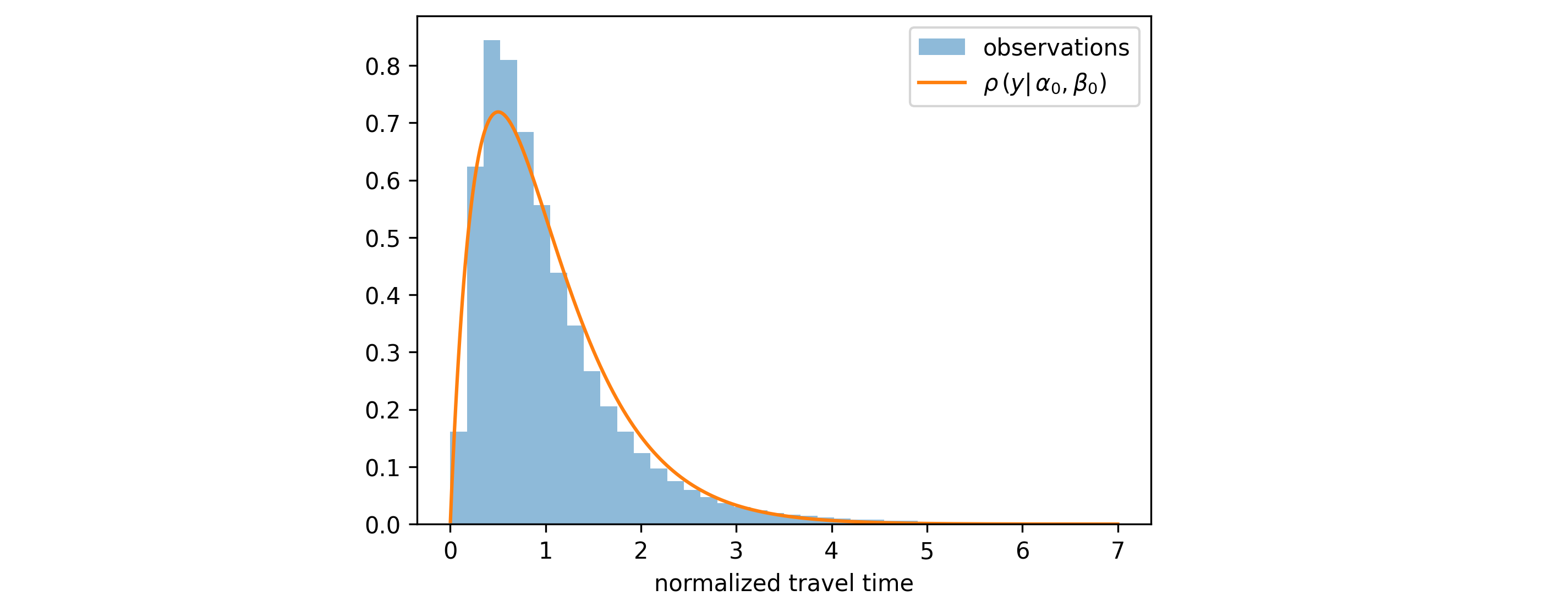
        <b>Step 1:</b> Find the optimal constant distribution parameters $\alpha_0$ and $\beta_0$ that minimize the loss
        over
        the entire training dataset:

        \begin{align}
        (\alpha_0, \beta_0) & = \underset{\alpha, \beta }{\mathrm{arg \ min}}
        \sum^{N}_{i=1} - \log\left[ \rho \left(y_i | \alpha, \beta \right) \right]
        \end{align}

        This is a simple optimization problem (no features involved) that can be solved using scipy's built-in
        <a href="https://en.wikipedia.org/wiki/Maximum_likelihood_estimation">maximum likelihood estimation</a> for the
        Gamma distribution.
    </li>

    <figure>
        <img src='https://raw.githubusercontent.com/ImScientist/ImScientist.github.io/master/assets/blog_content/probabilistic_prediction_lightgbm/featureless_model_fit.png'
             alt="Fit featureless model">
        <figcaption>Gamma probability distribution function $\rho(y | \alpha_0, \beta_0)$ with parameters $\alpha_0$,
            $\beta_0$ obtained by applying the maximum likelihood estimation method on the observed values of the target
            variable. In this example we use the trip travel times (normalized with the overall median) from the
            <a href="https://www.nyc.gov/site/tlc/about/tlc-trip-record-data.page">NYC taxi trip dataset</a>.
        </figcaption>
    </figure>

    <br>
    <li>
        <b>Step 2:</b> Convert these optimal parameters back to raw scores using the inverse mapping $g^{-1}$:
        \begin{align}
        a^0_1 & = \rm{softplus}^{-1}(\alpha_0 / \beta_0) \nonumber \\
        a^0_2 & = \rm{softplus}^{-1}(\beta_0)
        \end{align}
        where $\rm{softplus}^{-1}$ is the inverse of the softplus function.
    </li>
</ul>

<p>
    While we use constant initial scores here, you're not restricted to this approach. You could use a simpler model
    (e.g., linear regression) to predict feature-dependent initial scores, as long as you use the same loss function
    \eqref{eq:loss_fn} and you compute initial scores for every point in the training/validation dataset before growing
    trees. This can give your model a head start, especially if simple linear relationships exist in your data.
</p>


<h5 id="model_training_3">3.3 Growing Trees: The Objective Function</h5>

<p>
    Now comes the core of gradient boosting: iteratively growing trees to minimize the loss. To grow each tree, LightGBM
    requires an objective function that computes the <b>gradient</b> of the loss with respect to the raw scores
    (first-order derivatives), and the <b>diagonal of the Hessian</b> matrix (second-order derivatives). An explanation
    how the gradients and the Hessian impact the tree growth is provided in the
    <a href="https://xgboost.readthedocs.io/en/stable/tutorials/model.html">XGBoost tutorial</a> where an example of
    growing a single tree per iteration was considered, and Taylor expansion of the loss function up to the second order
    was applied. We would like to take a closer look at the latter step and see how it changes for our problem.
</p>


<h5 id="model_training_4">3.4 Taylor Approximation of the loss function</h5>

<p>
    The foundation of gradient boosting is a second-order Taylor expansion of the loss function w.r.t. the raw scores.
    We recall again the matrix notation for the raw scores used in \eqref{eq:lgbm_def_matrix}. When we grow the $T$-th
    pair of trees we update the raw scores by adding to them the matrix $A^t$ $(t=T)$ on the right-hand side. If we
    assume that the values of the new matrix $A^t$ $(t=T)$ are very small then the update of the total loss $L$ should
    be small, as well, which justifies the application of the second-order Taylor expansion w.r.t. $A^t$ $(t=T)$:

    \begin{align}
    \label{eq:loss_taylor}
    L^{[T]} &= \sum^{N}_{i=1} l^{[T]}_i \\
    & \approx \sum^{N}_{i=1} \Bigg( l^{[T-1]}_{i}
    + \sum^{2}_{j=1} \frac{dl_i}{dA_{ij}} \vast^{}_{A_i=A^{[T-1]}_i} \hspace{-13.0mm} A^{T}_{ij}
    \hspace{5.0mm}
    + \frac{1}{2} \sum^{2}_{jj'=1} \frac{d^2l_i}{dA_{ij} dA_{ij'}} \vast^{}_{A_i = A^{[T-1]}_i} \hspace{-13.0mm}
    A^{T}_{ij} A^{T}_{ij'}
    \hspace{3.0mm}
    \Bigg) \nonumber
    \end{align}

    There are few key observations:

<ul class="toc-list">
    <li>
        <b>Per-sample structure:</b> Each data point $i$ contributes independently to the loss, which is why the
        subscript
        on $l$ matches the first subscript on $A$ which refers to the $i$-th row.
    </li>
    <br>
    <li>
        <b>Mixed second derivatives:</b> The last term in the second line of \eqref{eq:loss_taylor} contains mixed
        derivatives, i.e. terms
        where $ij \neq ij'$. However, LightGBM only accepts <b>diagonal</b> Hessian terms.
    </li>
</ul>
</p>

<p>
    In this example you can see one of the drawbacks of growing more than one tree per iteration: we get mixed second
    order derivatives. Since we are asked to provide only the diagonal of the Hessian matrix in our objective function
    this means that we are practically dropping the mixed derivative terms from the Taylor expansion. The model loses
    important information that can impact the generation process of a new tree. If we were growing only one tree per
    iteration we would have never observed mixed second order derivatives, and this problem would not have been present.
    This approximation explains why we prefer some maps $g$ from raw scores $(a_1, a_2)$ to distribution parameters
    $(\alpha, \beta)$, like the one in \eqref{eq:g_map} to others.
</p>


<h3 id="model_evaluation">4. Model Evaluation</h3>

<p>
    Since we are predicting probability distributions, we would like to know if the model is able to correctly quantify
    its uncertainty about a prediction. For example, if the observed value lies between the predicted 10-th and 90-th
    percentile 80% of the times. In addition, we would like to know if the distributions are still sharp enough. To
    assess both properties we use different plots and metrics.
</p>

<h5 id="model_evaluation_1">4.1 Calibration plot</h5>

<p>
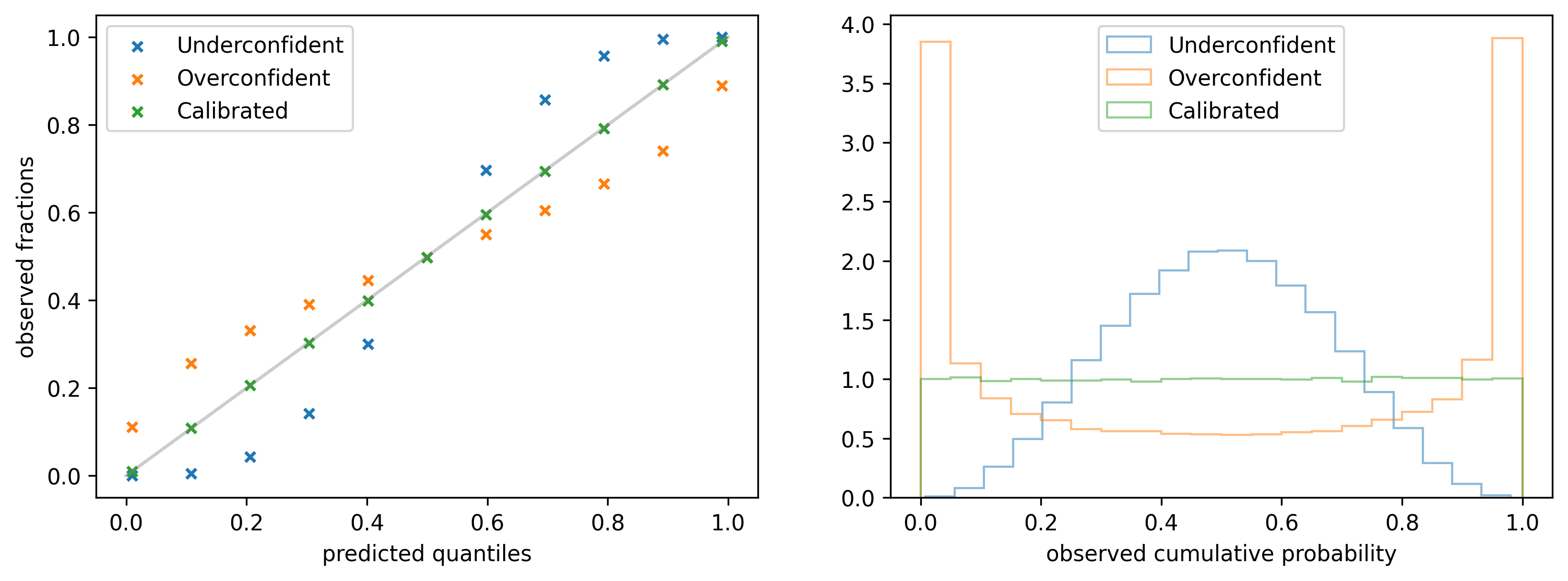
    It is obtained by picking a fixed quantile $y_p$ from the predicted distribution for each data point $x$ and
    calculating the fraction of observations that are below $y_p$ (y-axis). The operation is repeated for a list of
    quantiles, e.g. $0.1, 0.2, 0.3, \ldots$ (x-axis). If the model is perfectly calibrated the observed fractions should
    always match the quantiles, as it is shown in the left figure below (green marks).
</p>

<figure>
    <img src='https://raw.githubusercontent.com/ImScientist/ImScientist.github.io/master/assets/blog_content/probabilistic_prediction_lightgbm/calibration_plot.png'
         alt="Calibration plot">
    <figcaption>Calibration plot (left) and the corresponding Probability integral transform histogram (right) for three
        different types of models
    </figcaption>
</figure>

<h5 id="model_evaluation_2">4.2 Probability integral transform histogram</h5>

<p>
    An alternative representation of the same information is provided by the Probability integral transform (PIT): it is
    obtained by collecting the quantiles $q_i$ of the predicted distribution $\rho(y| \alpha(x_i), \beta(x_i))$ at which
    the observed values $y_i$ fall, and building a histogram. The quantiles are obtained with the following equation:

    \begin{align*}
    q_i & = \int^{y_i}_{0} \rho(y | \alpha (x_i), \beta(x_i)) dy \equiv CDF(y_i; \rho)
    \end{align*}

    where $CDF(y; ρ)$ refers to the cumulative distribution function of $\rho$ evaluated at $y$. On the right side of
    the figure above you can see the PIT histogram for three different types of models. For a calibrated model (green)
    the histogram should be uniform in the range $(0, 1)$.
</p>

<p>
    If a model is too uncertain about its predictions then the histogram might have a peak at $1/2$: in the example
    provided above (blue) 40% of the observations lie within the predicted 0.4 - 0.6 quantile range instead of 20%. To
    get this number one can either calculate the area btw 0.4 and 0.6 in the histogram or look at the calibration plot
    and subtract the observed fractions for the same two quantiles. It follows that the predicted quantiles 0.4 and 0.6
    are actually 0.3 and 0.7, respectively.
</p>

<p>
    On the other hand, if a model is too certain about its predictions it is likely to observe peaks in the distribution
    at 0 and 1. In the third example (orange) only 50% of the observations lie in the predicted 0.1 - 0.9 quantile range
    instead of 80%.
</p>

<figure>
    <img src='https://raw.githubusercontent.com/ImScientist/ImScientist.github.io/master/assets/blog_content/probabilistic_prediction_lightgbm/calibration_plot_trained_model.png'
         alt="Calibration plot trained model">
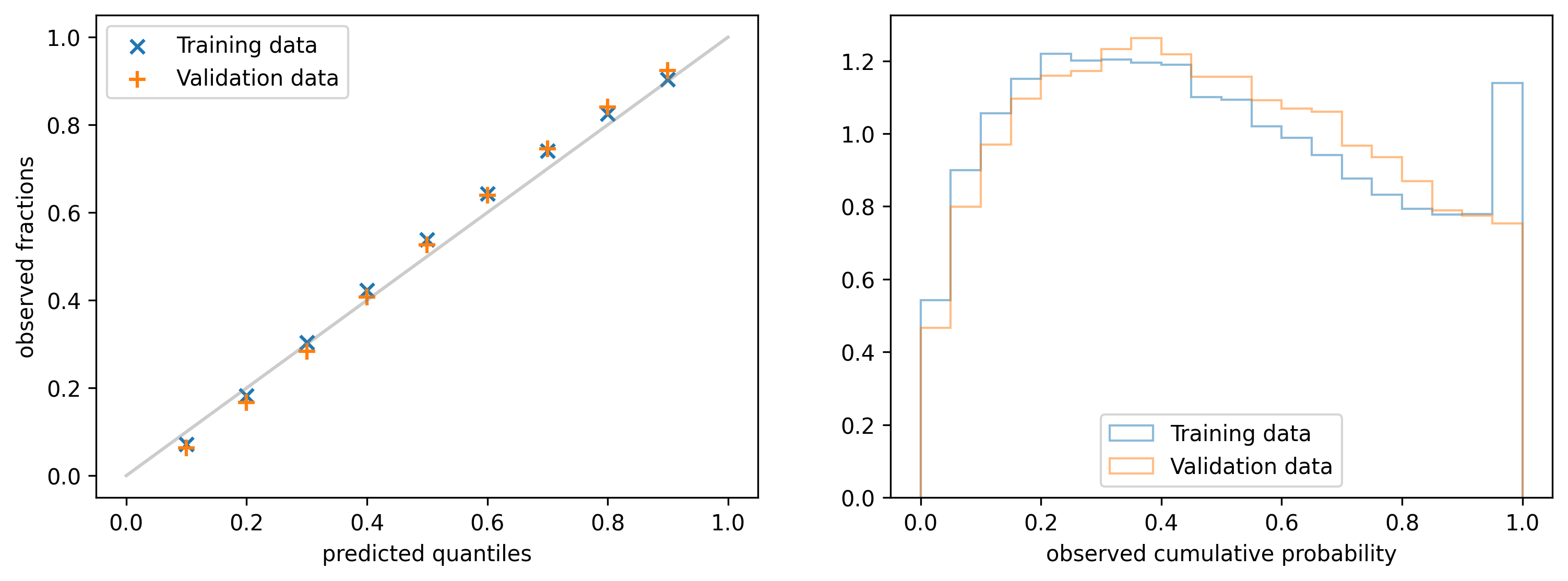
    <figcaption>Calibration plot (left) and the corresponding Probability integral transform histogram (right) for a
        LightGBM model trained on the NYC taxi trip dataset.
    </figcaption>
</figure>


<h5 id="model_evaluation_3">4.3 Relative standard deviation histogram</h5>

<p>
    If you look at the calibration plot of the model that uses only the initial score (generated before starting to
    train any tree) you will see that it is already calibrated. On the other hand, we expect that this model cannot be
    very sharp, i.e. it predicts wide distributions with high standard deviation. Our expectation is that the sharpness
    should improve after each training iteration. To measure it, we can calculate the (relative) standard deviation


    \begin{align*}
    \text{rel std}
    & = \frac{ STD [ \rho ] }{ \mathbb{E} [ \rho ] } = \frac{1}{\sqrt{\alpha(x)} }
    \end{align*}

    or the width of a fixed interquartile range of the predicted distribution $\rho(y|\alpha(x_i), \beta(x_i))$ for each
    $x_i$ and build a histogram from the obtained values.
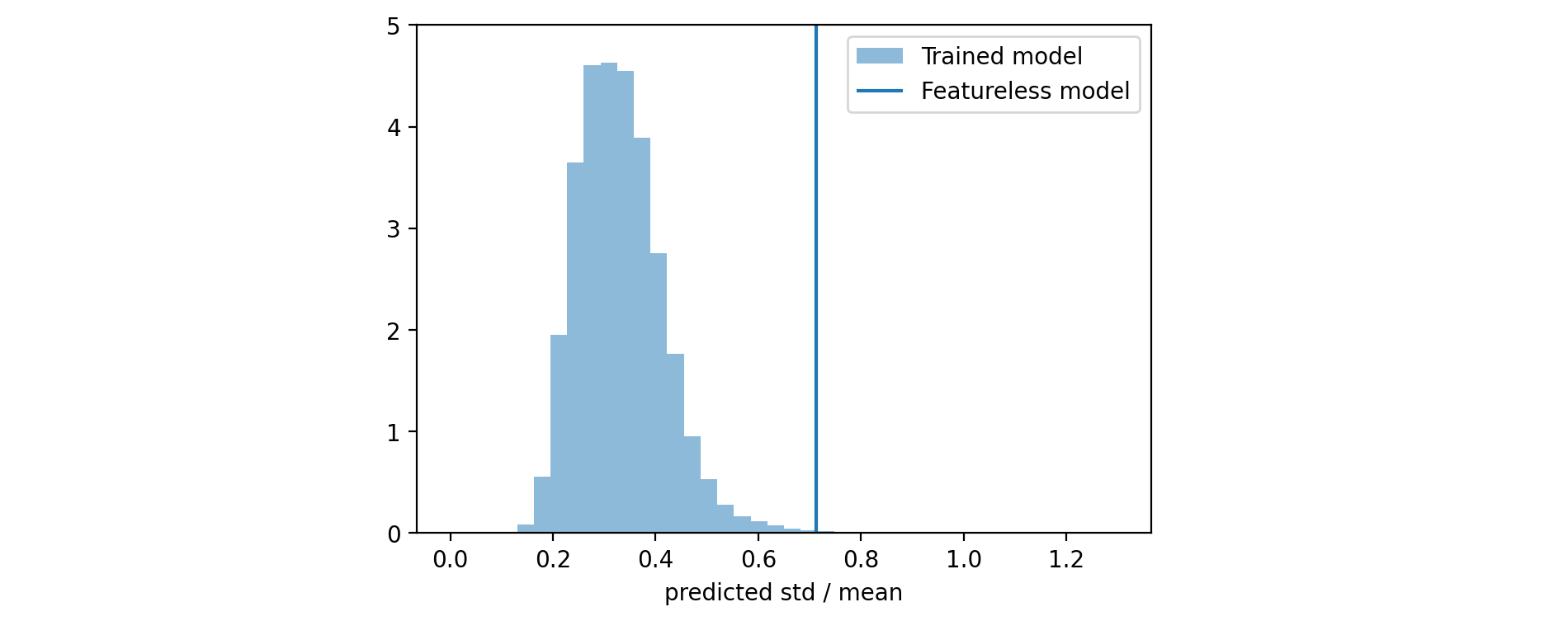
</p>

<figure>
    <img src='https://raw.githubusercontent.com/ImScientist/ImScientist.github.io/master/assets/blog_content/probabilistic_prediction_lightgbm/rel_std_trained_model_vs_0trees.png'
         alt="Relative std">
    <figcaption>Histogram of relative standard deviations of predicted trip travel time distributions. The distributions
        are parametrized by a Gamma probability distribution function $\rho(y|\alpha, \beta)$ and the parameters
        $\alpha, \beta$ are obtained from a LightGBM model. The vertical line is the relative std obtained when using a
        model with 0 trees, i.e. when we rely only on the initial scores $\alpha_0, \beta_0$.
    </figcaption>
</figure>


<h5 id="model_evaluation_4">4.4 Continuous ranked probability score (CRPS)</h5>


<figure>
    <img src='https://raw.githubusercontent.com/ImScientist/ImScientist.github.io/master/assets/blog_content/probabilistic_prediction_lightgbm/crps_example.png'
         alt="CRPS example">
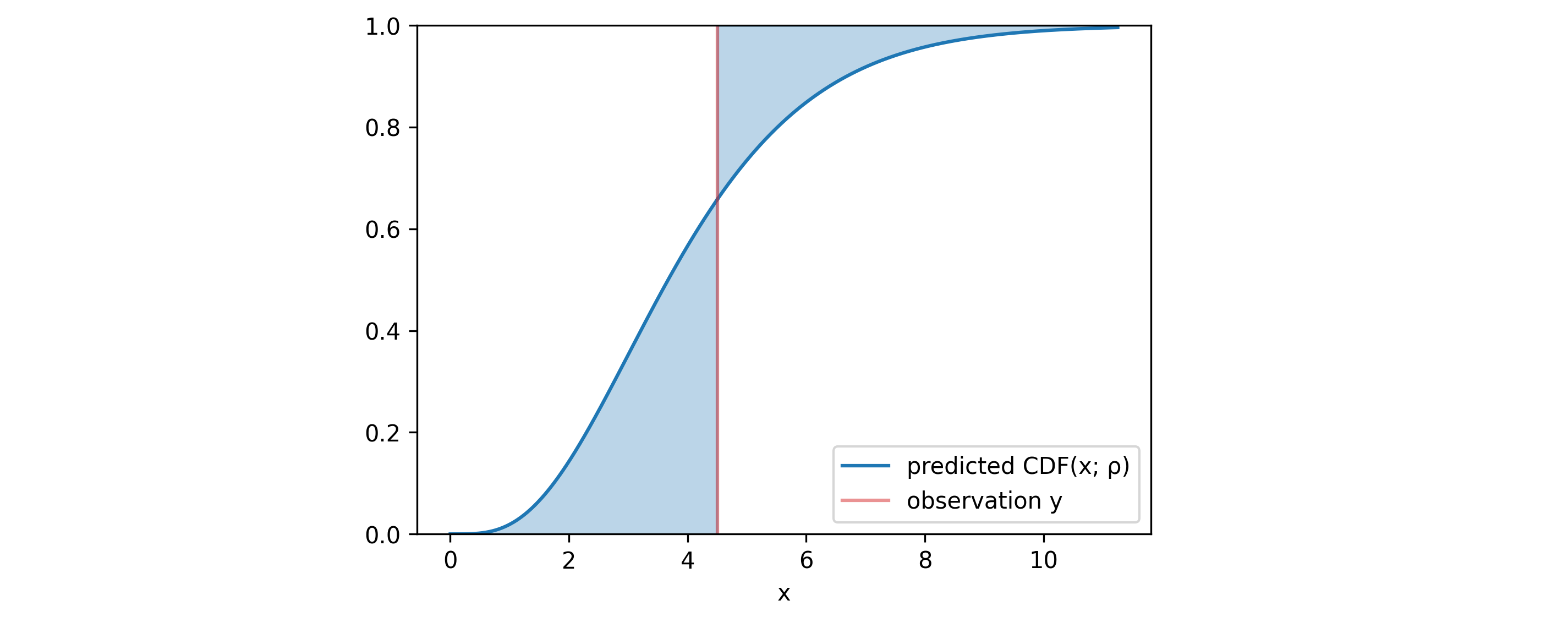
    <figcaption>Illustration of the CRPS for an observation $y=4.5$ and a predicted Gamma distribution with $(\alpha,
        \beta) = (4, 1)$.
    </figcaption>
</figure>

<p>
    In addition to these plots, one can use a metric that simultaneously evaluates both calibration and sharpness - the
    <a href="https://en.wikipedia.org/wiki/Scoring_rule#Continuous_ranked_probability_score">CRPS</a>. Given the observation $y$ and the predicted distribution $\rho$, it is defined as:

    \begin{align}
    CRPS(\rho, y)
    & = \int _{\mathbb{R}} \Big( CDF (x; \rho) - H(x-y) \Big)^2 dx
    \end{align}

    where $H$ is the Heavyside step function and $CDF(x; \rho)$ is the cumulative distribution function of $\rho$
    evaluated at $x$. The blue area in the figure above represents the difference between these two functions. The area,
    and with it the $CRPS$ would have been minimized if the median of $\rho$ matched with the observation $y$ and if the
    standard deviation of $\rho$ went to $0$. This limit refers to the case of the model delivering exact
    point-predictions.
</p>

<h3 id="dask">5. Practical Aspects of Model Training with Dask</h3>

<p>
    To demonstrate our probabilistic forecasting approach, we train the model on the <b>NYC Taxi Trip Dataset</b>, a
    public dataset containing trip records with pick-up and drop-off times, locations, distances, fares, and additional
    metadata. While data fetching, preprocessing, and feature engineering are straightforward and well-documented in our
    <a href="https://github.com/ImScientist/probabilistic-forecasting-travel-time-lightgbm">GitHub repository</a>, this section focuses on why we should use Dask for distributed training and what infrastructure
    is required to deploy the training pipeline on Google Cloud.
</p>

<h5 id="dask_1">5.1 Why Dask for Distributed LightGBM Training?</h5>

<p>
    The NYC taxi dataset's size necessitates distributed training - training on a single machine is either impossible or
    prohibitively slow. For distributed gradient boosting, practitioners typically choose between two main ecosystems:

<ul class="toc-list">
    <li>
        <b>Apache Spark + SynapseML.</b> It is a mature distributed computing framework with wide adoption but it has
        the critical limitation of not supporting training a LightGBM model with a custom loss-function, at least not
        through the PySpark API. An additional challenge is that PySpark generally discourages user-defined functions
        (UDFs) due to performance overhead from Python-JVM communication. Scala users might be able to overcome these
        limitations but this is outside of our scope.
    </li>
    <br>
    <li>
        <b>Dask + LightGBM.</b> Dask is an open-source library for parallel computing that is smaller and lighter weight
        than Spark. It is written in Python and offers a seamless integration with other python libraries like NumPy,
        pandas, and Scikit-learn. The native LightGBM library supports distributed learning via Dask and since version
        4.0.0 it supports custom
        loss functions, as well.
    </li>
</ul>

Since our probabilistic forecasting approach requires custom objective function to predict Gamma distribution parameters $(\alpha, \beta)$ the Dask + LightGBM approach becomes the only viable option for us. In addition, the transition from single-core to multi-core training requires, besides all the infrastructure changes, little changes in the python code: you have to transition from Pandas- to Dask-DataFrames for data preprocessing, and to take into account that the data does not reside on the same machine, but besides this the code remains the same.

</p>

<h5 id="dask_2">5.2 Cloud Infrastructure Setup on Google Cloud Platform</h5>

<p>
    We will use Google cloud to create the infrastructure required to train the model:
<ul class="toc-list">
    <li>
        A service account to which we will assign different access rights.
    </li>
    <br>
    <li>
        Google cloud storage (GCS) where we will store the training data and the artifacts of the trained model.
    </li>
    <br>
    <li>
        A Kubernetes cluster for the training.
    </li>
</ul>

This can be achieved with the
<a href="https://cloud.google.com/sdk/docs/install">gcloud cli</a>. All the required commands can be squeezed in a single
<a href="https://github.com/ImScientist/probabilistic-forecasting-travel-time-lightgbm/blob/master/create_infra.sh">shell script</a>. More details can be found in the
<a href="https://github.com/ImScientist/probabilistic-forecasting-travel-time-lightgbm/tree/master?tab=readme-ov-file#2-create-gcp-infrastructure">README</a> description of the repository.
</p>


<h5 id="dask_3">5.3 Dask Deployment on Kubernetes</h5>

<p>
    Once the resources are ready, we can use one of the official
    <a href="https://github.com/dask/helm-chart">Helm charts</a> to set up Dask. The deployment that we will
    use creates a single Dask scheduler that coordinates the task execution, several Dask workers that execute the
    computation, and a Jupyter Lab interactive environment for development and experimentation. You can use a jupyter
    notebook inside Jupiter Lab to execute the data collection, data preprocessing and model training steps. In the end,
    you have to destroy the Kubernetes cluster since it incurs high costs.
</p>

<p>
    This setup is thought more for experimentation. An automation of the training workflow can be achieved with Vertex
    AI where the computational resources will be automatically released (destroyed) once the training is done.
</p>

<h3 id="references">6. References</h3>

<ul class="toc-list">
    <li>
        <a href="https://github.com/ImScientist/probabilistic-forecasting-travel-time-lightgbm">Source code</a>
    </li>
    <li>
        <a href="https://xgboost.readthedocs.io/en/stable/tutorials/model.html">Introduction to Boosted Trees</a>
    </li>
    <li>
        <a href="https://medium.com/@maltetichy/how-to-fix-mean-absolute-error-8f690025574c">How to fix Mean Absolute
            Error</a>
    </li>
    <li>
        <a href="https://medium.com/@maltetichy/demystifying-the-probability-integral-transform-77b7de3a3af9">Demystifying
            the Probability Integral Transform</a>
    </li>
</ul>]]></content><author><name>ImScientist</name></author><summary type="html"><![CDATA[Use LightGBM to make probabilistic predictions of a continuous variable. We cover aspects about the model architecture, training and evaluation that are specific for probabilistic models: the reasoning behind the choice of the initial score, custom…]]></summary><media:thumbnail xmlns:media="http://search.yahoo.com/mrss/" url="https://raw.githubusercontent.com/ImScientist/ImScientist.github.io/master/assets/blog_content/probabilistic_prediction_lightgbm/Logo_lightgbm_12.png" /><media:content medium="image" url="https://raw.githubusercontent.com/ImScientist/ImScientist.github.io/master/assets/blog_content/probabilistic_prediction_lightgbm/Logo_lightgbm_12.png" xmlns:media="http://search.yahoo.com/mrss/" /></entry><entry><title type="html">Building a Conversational AI with RAG</title><link href="https://imscientist.dev/2025/08/23/conversational-ai-rag/" rel="alternate" type="text/html" title="Building a Conversational AI with RAG" /><published>2025-08-23T00:00:00+00:00</published><updated>2025-08-23T00:00:00+00:00</updated><id>https://imscientist.dev/2025/08/23/conversational-ai-rag</id><content type="html" xml:base="https://imscientist.dev/2025/08/23/conversational-ai-rag/"><![CDATA[<p>
    Imagine having a personal AI assistant that can answer questions about specific documents or knowledge bases while remembering your entire conversation history. This project demonstrates exactly that by implementing a Retrieval-Augmented Generation (RAG) system deployed on Kubernetes that combines the power of large language models with your own data.
</p>

<p>
    In this article, we'll explore how this system works by breaking down each component in simple terms. By the end of this guide, you'll understand how to build your own intelligent conversational agent that can work with any type of document or knowledge base. The full code can be found in this <a href="https://github.com/ImScientist/agents">Github repository</a>.
</p>

<h3>Table of Contents</h3>
<p>
<ol class="toc-list">
    <li>
        <a href="#what_is_rag">
            <span class="title">What is RAG and Why Does It Matter?</span>
        </a>
    </li>
    <li>
        <a href="#architecture">
            <span class="title">System Architecture Overview</span>
        </a>
    </li>
    <li>
        <a href="#components">
            <span class="title">Component Breakdown</span>
        </a>
    </li>
    <li>
        <a href="#how_it_works">
            <span class="title">How Everything Works Together</span>
        </a>
    </li>
    <li>
        <a href="#getting_started">
            <span class="title">Getting Started</span>
        </a>
    </li>
    <li>
        <a href="#advantages">
            <span class="title">Advantages of This Architecture</span>
        </a>
    </li>
    <li>
        <a href="#summary">
            <span class="title">Summary</span>
        </a>
    </li>
    <li>
        <a href="#rag_resources">
            <span class="title">Resources</span>
        </a>
    </li>
</ol>
</p>

<h3 id="what_is_rag">1. What is RAG and Why Does It Matter?</h3>

<p>
    Retrieval-Augmented Generation (RAG) is a technique that enhances AI chatbots by giving them access to specific information beyond their training data. Traditional AI models are limited to the information they learned during their training process, which means they can't access real-time information or answer questions about documents they've never seen before.
</p>

<p>
    A RAG system works by first searching through your documents to find relevant information, then retrieving the most relevant pieces of text, and finally generating responses using both the retrieved information and the AI's existing knowledge. This approach solves the critical problem of knowledge cutoffs and enables AI systems to work with domain-specific information that wasn't part of their original training data.
</p>

<p>
    The power of RAG lies in its ability to make AI systems more accurate, up-to-date, and relevant to specific use cases. Instead of hallucinating or providing outdated information, the AI can reference actual documents and provide citations for its responses.
</p>

<h3 id="architecture">2. System Architecture Overview</h3>

<p>
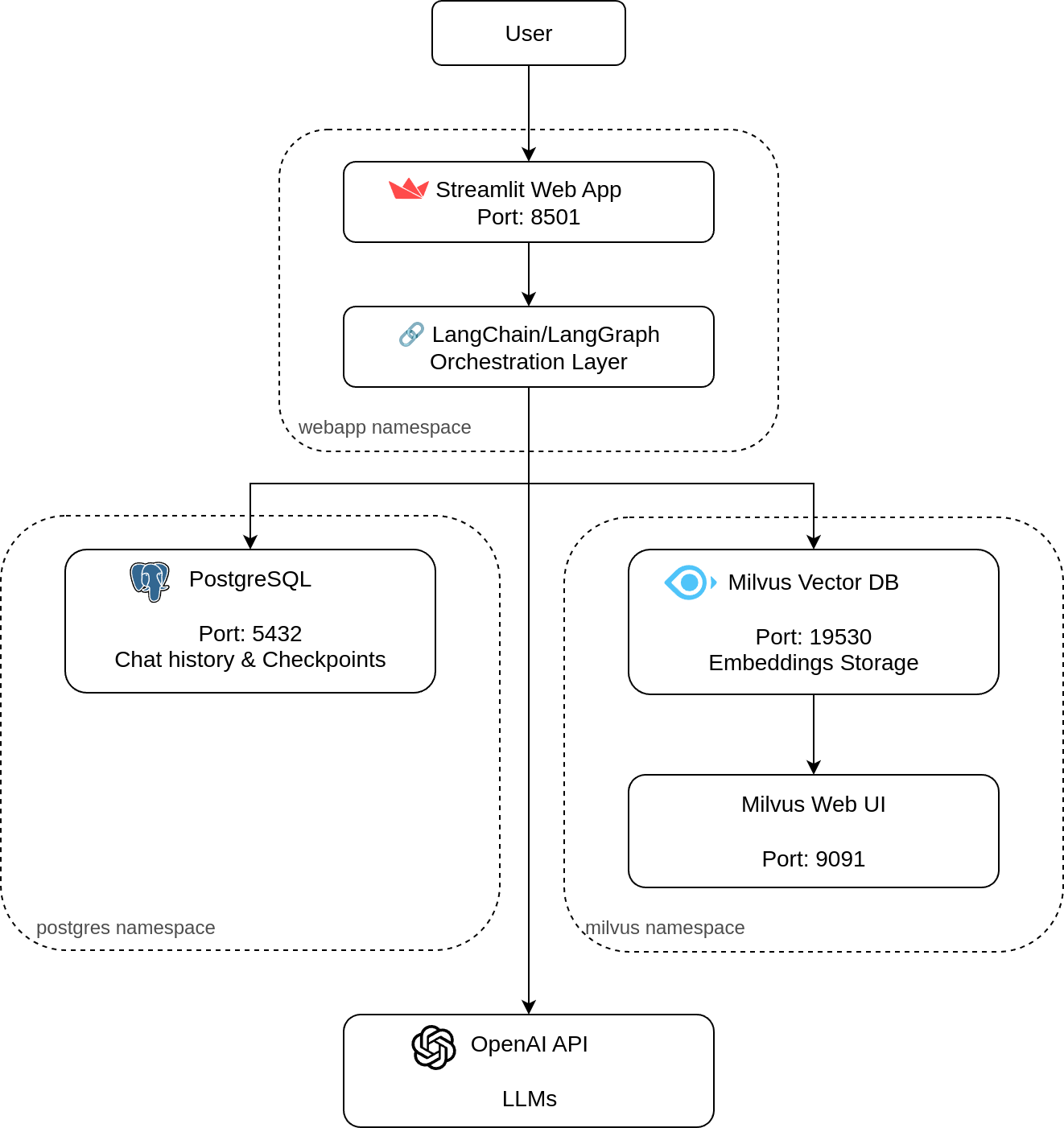
    Our RAG system consists of several key components working together in a coordinated workflow. When a user submits a question through the Streamlit web application, the request flows through a LangGraph RAG chain that intelligently decides whether to search the vector database for relevant information. The system then combines any retrieved information with the conversation context stored in PostgreSQL before sending everything to the OpenAI GPT model for final response generation.
</p>

<p>
    This architecture ensures that every response is both contextually aware of the ongoing conversation and informed by the most relevant information from your document collection. The entire system runs on Kubernetes, providing scalability, reliability, and easy management of all components.
</p>


<figure>
    <img src='https://raw.githubusercontent.com/ImScientist/ImScientist.github.io/master/assets/blog_content/conversational_ai_rag/project_diagram_2.png' alt="image" >
</figure>


<h3 id="components">3. Component Breakdown</h3>

<h5>3.1 LangChain & LangGraph - The AI Orchestration</h5>

<p>
    LangChain serves as the foundation for building applications with large language models, while LangGraph extends these capabilities to create stateful, multi-step AI workflows. Together, they form the brain of our RAG system, orchestrating the complex dance between user input, information retrieval, and response generation.
</p>

<figure>
    <img src='https://raw.githubusercontent.com/ImScientist/ImScientist.github.io/master/assets/blog_content/conversational_ai_rag/langchain_graph_3.png' alt="graph">
</figure>

<p>
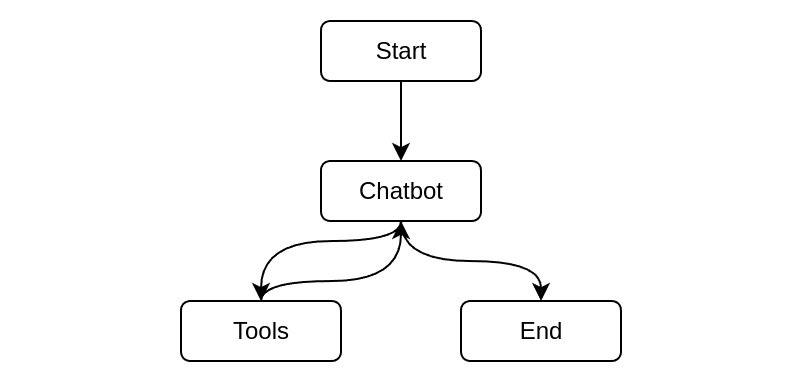
    The core logic of the graph is described in the figure above. The system works by receiving user questions and making intelligent decisions about how to respond.

    <ul>
        <li>
            For simple queries that don't require additional context, the system might respond directly using the AI's existing knowledge (right path).
        </li>
        <br>
        <li>
            However, for questions that would benefit from specific information, LangGraph may decide to use the tools (left path) that you have provided to gather extra information: for example, that could be a tool that executes online searches or a tool that retrieves relevant documents from an internal database. Once relevant information is retrieved, LangGraph coordinates the combination of this context with the user's original question and the ongoing conversation history, and decides whether to use another tool or to prepare a response. This orchestration ensures that responses are not only accurate based on the retrieved information but also coherent within the context of the entire conversation thread.
        </li>
    </ul>
</p>

<h5>3.2 OpenAI GPT - The Language Model</h5>

<p>
    The OpenAI GPT model serves as the core intelligence of our system, providing natural language understanding and generation capabilities that make conversations feel human-like and intuitive. The language model performs multiple critical functions within our system.
</p>

<ul>
    <li>
        First, it analyzes incoming user questions to determine whether additional information retrieval is necessary or if the question can be answered directly from the model's existing knowledge. This decision-making capability prevents unnecessary tool usage and improves response times for simple queries.
    </li>
    <br>
    <li>
        In addition, when the system retrieves relevant information after using one of the tools, the GPT model synthesizes this information with the conversation context to generate comprehensive, coherent responses.
    </li>
</ul>

<h5>3.3 Milvus - The Vector Database</h5>

<p>
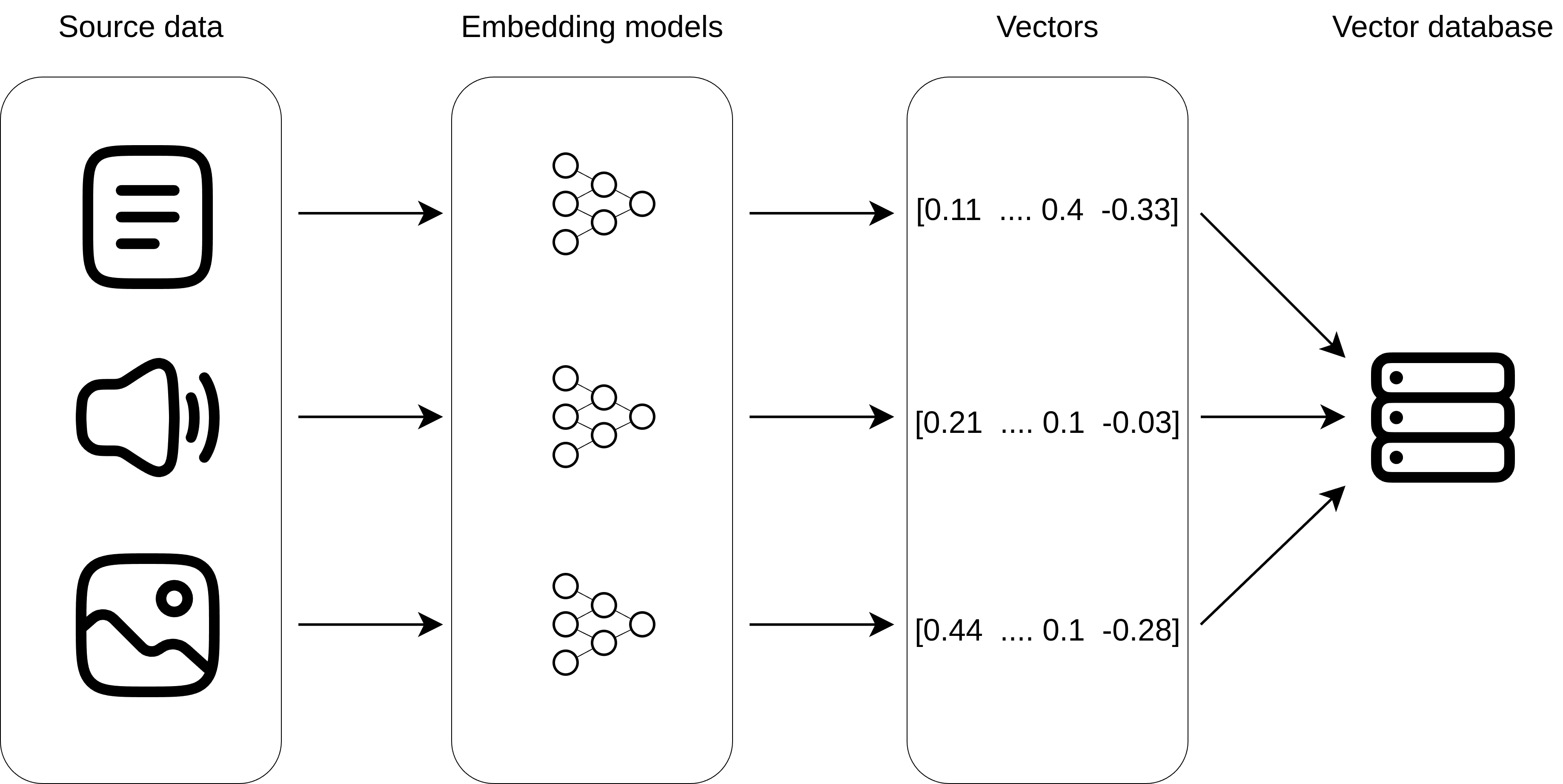
    Milvus represents a specialized database technology designed specifically for storing and searching through vector embeddings, which are numerical representations of text that capture semantic meaning. This component transforms how we search and retrieve information, moving beyond simple keyword matching to true semantic understanding.
</p>

<figure>
    <img src='https://raw.githubusercontent.com/ImScientist/ImScientist.github.io/master/assets/blog_content/conversational_ai_rag/vectordb.png' alt="graph">
</figure>

<p>
    The process begins when documents are processed and split into manageable chunks, typically a few hundred words each. Each chunk is then converted into a high-dimensional vector using OpenAI's embedding model, which captures the semantic meaning of the text in mathematical form. These embeddings are stored in Milvus along with the original text and relevant metadata.
</p>

<p>
    When a user asks a question, the system converts their query into the same type of vector embedding and searches through the database to find the most semantically similar content. This approach enables the system to find relevant information even when the exact words don't match. For example, a search for "car problems" might successfully return documents about "automotive issues" or "vehicle maintenance" because the vector representations capture the underlying semantic relationships.
</p>

<p>
    The sophistication of vector-based search cannot be overstated. Traditional keyword searches often miss relevant information due to variations in terminology, but vector search understands context and meaning, dramatically improving the quality of information retrieval.
</p>

<h5>3.4 PostgreSQL - The Memory System</h5>

<p>
    PostgreSQL serves as the memory backbone of our conversational AI system, storing conversation history and checkpoints that enable the AI to maintain context across multiple interactions. This database management system ensures that each conversation thread maintains continuity and coherence, regardless of how long the interaction continues.
</p>

<p>
    The importance of persistent memory in conversational AI cannot be understated. Without proper memory management, each interaction would be isolated, forcing users to repeatedly provide context and preventing the development of more sophisticated, multi-turn conversations that feel natural and productive.
</p>

<h5>3.5 Streamlit - The User Interface</h5>

<p>
    Streamlit serves as the user-facing component of our system, providing a clean and intuitive web interface for interacting with the AI assistant. This Python framework allows developers to create sophisticated web applications without extensive web development knowledge, making it an ideal choice for data science and AI applications. The biggest advantage of streamlit is the easy management of different user sessions: you can open two tabs of the same application, start two different conversations, and there will be no information leak between them.
</p>

<h5>3.6 Kubernetes - The Deployment Platform</h5>

<p>
    Kubernetes orchestrates the deployment and management of all system components, providing a robust platform that handles scaling, reliability, and inter-service communication. This container orchestration platform ensures that our RAG system can operate reliably in production environments while maintaining the flexibility to scale based on demand.
</p>

<p>
    Each component of our system runs in its own containerized environment, managed by Kubernetes. This approach provides isolation between services, making the system more resilient to failures and easier to maintain. If one component experiences issues, the others continue operating normally, and Kubernetes can automatically restart failed services to maintain system availability.
</p>

<p>
    The platform also manages networking between components, ensuring secure communication channels and proper service discovery. When the Streamlit application needs to communicate with the vector database or the PostgreSQL instance, Kubernetes handles the routing and load balancing automatically. This infrastructure management allows developers to focus on application logic rather than deployment complexities.
</p>

<p>
    For organizations planning to scale their RAG systems, Kubernetes provides horizontal scaling capabilities that can automatically add more resources during peak usage periods and scale down during quieter times. This elasticity ensures optimal performance while controlling infrastructure costs.
</p>

<h3 id="how_it_works">4. How Everything Works Together</h3>

<p>
    Understanding the complete workflow helps illustrate how these components create a cohesive, intelligent system. When a user submits a question through the Streamlit interface, the application immediately saves this interaction to the conversation history and forwards the query to the LangGraph workflow engine.
</p>

<p>
    LangGraph analyzes the incoming question using the OpenAI language model to determine the appropriate response strategy. For questions that clearly require specific information not available in the model's training data, the system triggers its retrieval mechanism. This involves converting the user's question into a vector embedding and searching the Milvus database for semantically similar content.
</p>

<p>
    The vector database returns the most relevant document chunks, which LangGraph then combines with the original user question and the complete conversation history stored in PostgreSQL. This comprehensive context package is sent to the OpenAI GPT model, which synthesizes all available information into a coherent, conversational response that directly addresses the user's query.
</p>

<p>
    Throughout this process, every interaction is preserved in PostgreSQL, ensuring that subsequent questions can build upon previous exchanges and maintain conversational continuity. The final response appears in the Streamlit interface, completing the cycle and preparing the system for the next user interaction.
</p>

<h3 id="getting_started">5. Getting Started</h3>

<p>
    The repository provides comprehensive setup instructions that guide users through both local development and production deployment scenarios. For developers wanting to experiment and modify the system, local setup allows running all components on a single machine, making it easy to test changes and understand how the components interact.
</p>

<p>
    Production deployment leverages Kubernetes to provide a scalable, reliable system suitable for real-world usage. The setup process includes detailed instructions for configuring each component, managing secrets and environment variables, and establishing proper networking between services.
</p>

<p>
    Essential prerequisites include obtaining an OpenAI API key for accessing the language model and embedding services, setting up a Kubernetes cluster for deployment, and basic familiarity with Docker containers and command-line tools. The system requires several environment variables including OPENAI_API_KEY for the language model, POSTGRES_CONN_STRING for database connectivity, and MINIO_URI with MINIO_ACCESS_TOKEN for vector database access.
</p>

<h3 id="advantages">6. Advantages of This Architecture</h3>

<p>
    The modular design of this system provides significant advantages for both development and maintenance. Each component can be updated, scaled, or replaced independently without affecting the entire system, making it easier to incorporate new technologies or adapt to changing requirements.
</p>

<p>
    Kubernetes provides inherent scalability that automatically adjusts to usage patterns, ensuring optimal performance during peak periods while controlling costs during lighter usage. The system can handle multiple simultaneous users without degradation, making it suitable for organizational deployment.
</p>

<p>
    Cost-effectiveness comes from using efficient models and intelligent retrieval that only accesses relevant information. Rather than processing entire document collections for every query, the system precisely identifies and retrieves only the most relevant content, minimizing computational overhead and API costs.
</p>

<p>
    The clear separation of concerns makes debugging and troubleshooting straightforward. Issues can typically be isolated to specific components, and the comprehensive logging throughout the system provides visibility into the processing pipeline for optimization and problem resolution.
</p>


<h3 id="summary">7. Summary</h3>

<p>
    This project demonstrates a production-ready approach to building conversational AI systems that seamlessly integrate with existing organizational knowledge. By combining modern AI frameworks, specialized databases, and cloud-native deployment practices, the architecture provides a robust foundation for intelligent applications that can adapt to virtually any domain or use case.
</p>

<p>
    The flexibility of this approach means that organizations can customize the system for their specific needs by simply changing the data sources and adjusting the configuration. Whether building customer support tools, educational platforms, research assistants, or internal knowledge management systems, this foundation provides the scalability, intelligence, and reliability necessary for real-world deployment.
</p>

<p>
    The future of AI applications is increasingly conversational, contextual, and connected to real-world information. This project provides not just a working implementation but a blueprint for understanding how these technologies can be combined effectively. By exploring the code, experimenting with different data sources, and adapting the system to specific requirements, developers and organizations can build AI applications that truly serve their users' needs while leveraging the full potential of modern artificial intelligence technologies.
</p>

<h3 id="rag_resources">8. Resources</h3>
<p>
    <ul>
        <li>
            [1] <a href="https://github.com/ImScientist/agents">
            Source code</a>
        </li>
    </ul>
</p>]]></content><author><name>ImScientist</name></author><summary type="html"><![CDATA[Learn how to build an intelligent conversational AI system that combines RAG with your own documents, deployed on Kubernetes. This guide demonstrates how to create a personal AI assistant with conversation memory using LangGraph, OpenAI GPT, Milvus…]]></summary><media:thumbnail xmlns:media="http://search.yahoo.com/mrss/" url="https://raw.githubusercontent.com/ImScientist/ImScientist.github.io/master/assets/blog_content/conversational_ai_rag/agents_thumbnail.png" /><media:content medium="image" url="https://raw.githubusercontent.com/ImScientist/ImScientist.github.io/master/assets/blog_content/conversational_ai_rag/agents_thumbnail.png" xmlns:media="http://search.yahoo.com/mrss/" /></entry><entry><title type="html">Optimal asset reallocation strategies</title><link href="https://imscientist.dev/2025/01/20/asset-reallocation/" rel="alternate" type="text/html" title="Optimal asset reallocation strategies" /><published>2025-01-20T00:00:00+00:00</published><updated>2025-01-20T00:00:00+00:00</updated><id>https://imscientist.dev/2025/01/20/asset-reallocation</id><content type="html" xml:base="https://imscientist.dev/2025/01/20/asset-reallocation/"><![CDATA[<p>
    We investigate optimal strategies for reallocating investments from a risk-free asset class $B$ to a risky asset
    class $S$ that offers higher average returns but also comes with greater volatility. The primary objective is to
    determine the optimal trade-off between maximizing returns and minimizing volatility over a one-year period. We
    explore whether it is more advantageous to move all assets from $B$ to $S$ at the beginning of the year or to
    distribute the reallocation in portions over time. The results can be reproduced with the code in this
    <a href="https://gist.github.com/ImScientist/91f0f2084effd9df97db576c05d4c8f1">GitHub Gist</a> and
    <a href="https://colab.research.google.com/drive/1xTyq81cZpvRJt22_xqsxjwHG_20LZbn2?usp=sharing">Colab Notebook</a>.
</p>

<h3>1. Problem description</h3>

<p>
    Assume that initially all investments are allocated in an asset class $B$ which has a fixed return rate $r$. A
    second asset class $S$ has higher average return rate $\mu$ than $B$ but comes with higher volatility: there is a
    chance that its returns are much lower than $r$. The goal is to transition all assets to $S$ within one year. This
    is done at equidistant points in time $\{t_j |j=0, \ldots N\}$ by transferring fractions $\{ \alpha_j | j=0, \ldots
    N\} $ of the initial investment in $B$ to $S$. For example, if we decide to do this operation once every 4 months
    then the fractions are described by a 4-dimensional vector $\alpha=[\alpha_0, \alpha_1, \alpha_2, \alpha_3]$ whose
    elements are non-negative and sum up to $1$: we sell $B$ and buy $S$ at the 0th, 4th, 8th and 12th month of the time
    interval. A graphical description for the case where the time span between two sell events $\Delta T$ is 4 months is
    provided below.
</p>

<figure>
    <img src='https://raw.githubusercontent.com/ImScientist/ImScientist.github.io/master/assets/blog_content/asset_reallocation/allocation_process.jpg' alt="image">
</figure>

<p>
    We are interested in the overall portfolio's growth $G$ in the end of the one-year interval. It is given by:
</p>

\begin{align}
\label{eq:g_definition}
G & = \sum^{N}_{n=0} \alpha_n   \frac{ B(n \, \Delta T) }{ B(0) }  \frac{ S(N \, \Delta T) }{ S(n \, \Delta T ) }
\end{align}

<p>
    Each term in \eqref{eq:g_definition} describes the relative value growth of investments initially allocated in $B$
    and then moved to $S$ at $n\Delta T$. The first fraction is the relative growth of $B$ from $t=0$ to $t=n\Delta T$
    (the time we sell this asset) and the second fraction - the relative growth of $S$ from $n\Delta T$ to $N\Delta T$
    (the end of the one-year window). In the previous example $\Delta T=4$ months and $N=3$.
</p>

<p>
    Since the time evolution of $S$ is described by a stochastic process, the fractions $S(N\Delta T)/S(n \Delta T)$ are
    random variables, and hence the portfolio's growth $G$ is a random variable, as well. We want to understand how the
    mean, standard deviation (std) and particular percentiles of the probability distribution describing $G$ change as
    we change the allocation strategy $\alpha$. Intuitively, we know that achieving higher average returns is at the
    cost of higher std, and worse worst case performance scenarios (described by the low percentiles of the
    $G$-distribution). Nevertheless, there are strategies that offer the same average returns as other strategies but
    with a lower volatility, and we would like to identify them.
</p>

<h3>2. Time evolution of the asset classes</h3>

<p>
    As mentioned in the previous section, the two asset classes $B$ and $S$ have different behaviour. The risk-free
    asset $B$ provides a constant return rate $r$, leading to predictable exponential growth. Conversely, the risky
    asset $S$ is modeled using a Geometric Brownian motion, characterized by a drift parameter $\mu$ and a volatility
    parameter $\sigma$. The time evolution of $B$ is straightforward, represented by the equation
</p>

\begin{align}
B_t &= B_0  \,  \exp(r \, t)
\end{align}

<p>
    For the risky asset $S$, we describe its random fluctuations over time with the stochastic differential equation
</p>

\begin{align}
dS_t & = \mu \, S_t \, dt + \sigma \, S_t \, dW_t
\end{align}

<p>
    where $W_t$ is a Wiener process. The solution to this equation is given by:
</p>

\begin{align}
\label{eq:s_solution}
S_t &= S_0 \, \exp( (\mu - \sigma^2/2) \, t + \sigma \, W_t)
\end{align}

<p>
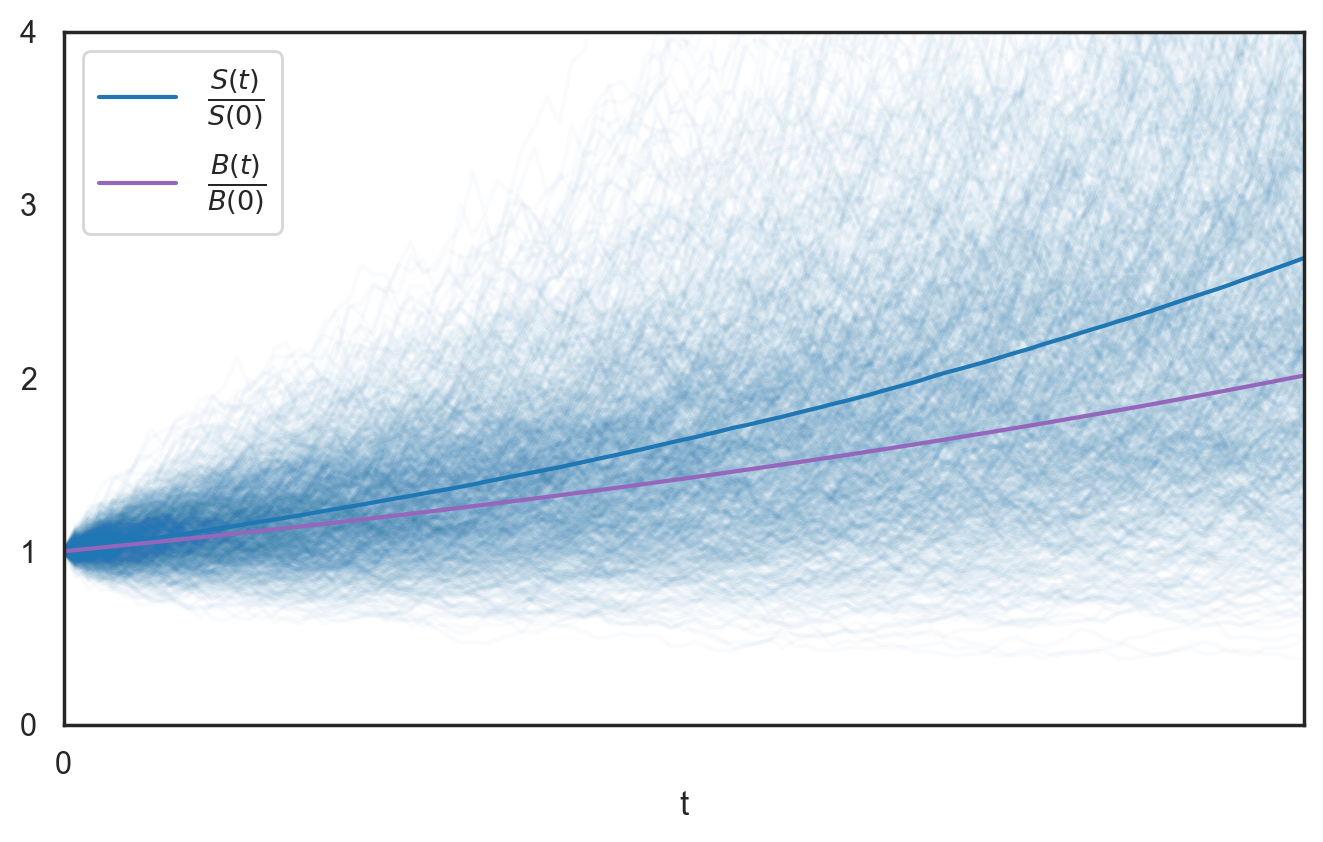
    Drawing the time evolution of $B_t$ is straightforward. On the other hand, to visualize the evolution of $S_t$ we
    simulate multiple trajectories of its stochastic process, allowing us to observe the variability in outcomes, as
    shown in the figure below.
</p>

<figure>
    <img src='https://raw.githubusercontent.com/ImScientist/ImScientist.github.io/master/assets/blog_content/asset_reallocation/process_time_evolution.png'
         alt="Trajectories of a stochastic process">
    <figcaption> Time evolution of multiple samples of $S_t$. The solid blue line is obtained from the mean of the
        sampled trajectories.
    </figcaption>
</figure>


<h3>3. Solution of the optimization problem</h3>

<p>
    To understand how the distribution of $G$ given $\alpha$ looks like, we have to sample many trajectories of the
    process $S_t$, and calculate $G$ for each one of them. Then we can examine the resulting histogram of results to
    calculate the metrics we are interested in such as mean, std, and percentiles. In the appendix we demonstrate how to
    sample trajectories of $S_t$ and use them to generate samples of $G$.
</p>

<p>
    In the following experiments we measure the time in units of years ($N\Delta T=1$ and $\Delta T=1/N$) and set $(r,
    \mu, \sigma) = (0.03, 0.09, 0.14)$ which means that the relative growths $B_t/B_0$ and $S_t/S_0$ satisfy the
    following relations after one year:
</p>

\begin{align*}
\frac{B(1)}{B(0)} & = \exp(r) \approx 1.03 \\
\mathbb{E} \left[ \frac{S(1)}{S(0)} \right] & = \exp(\mu) \approx 1.09 \\
\text{STD} \left[ \frac{S(1)}{S(0)} \right]  & =
\exp(\mu) (\exp(\sigma^2) - 1)^{1/2} \approx 0.15
\end{align*}

<p>
    i.e. an investment in $B$ or $S$ is expected to yield an average annual growth of $3\%$ or $9\%$, respectively.
    These figures are typical for returns from a bank savings account or an index fund investment.
</p>

<p>
    Given this insight, what typical values can we expect for $G$? The mean and standard deviation of $G$ should always
    fall between the corresponding metrics of $B_t/B_0$ and $S_t/S_0$ as shown below:
</p>

\begin{align}
\label{eq:g_inequalities}
\frac{B(1)}{B(0)} & \le  \mathbb{E} \left[ G \right]  \le  \mathbb{E} \left[ \frac{S(1)}{S(0)} \right] &
0 & \le \text{STD} \left[ G \right] \le  \text{STD} \left[ \frac{S(1)}{S(0)} \right]
\end{align}

<p>
    Obtaining the lowest possible mean and standard deviation is achieved by delaying the reallocation of all $B$ assets
    until the very end of the year, represented by $\alpha = [0 \ldots 0, 1]$. Conversely, to reach the highest limits,
    we reallocate all $B$ assets at the start of the year, represented by $\alpha = [1, 0 \ldots 0 ]$. This can be
    directly seen if we use the two $\alpha$-vectors in \eqref{eq:g_definition}:
</p>

\begin{align*}
G &  = \sum^{N}_{n=0} \alpha_n   \frac{ B(n/N) }{ B(0) }  \frac{ S(1) }{ S(n/N ) }
=     \begin{cases}
\frac{ B(1) }{ B(0) }, & \text{if } \alpha=[0, \ldots 0, 1] \\
& \\
\frac{ S(1) }{ S(0) }, & \text{if } \alpha=[1, 0 \ldots 0] \\
\end{cases}
\end{align*}

<h5>3.1 Example: 4-step uniform reallocation</h5>

<p>
    We examine the strategy of selling $25\%$ of our $B$ shares every 4 months (at the 0th, 4th, 8th, and 12th months),
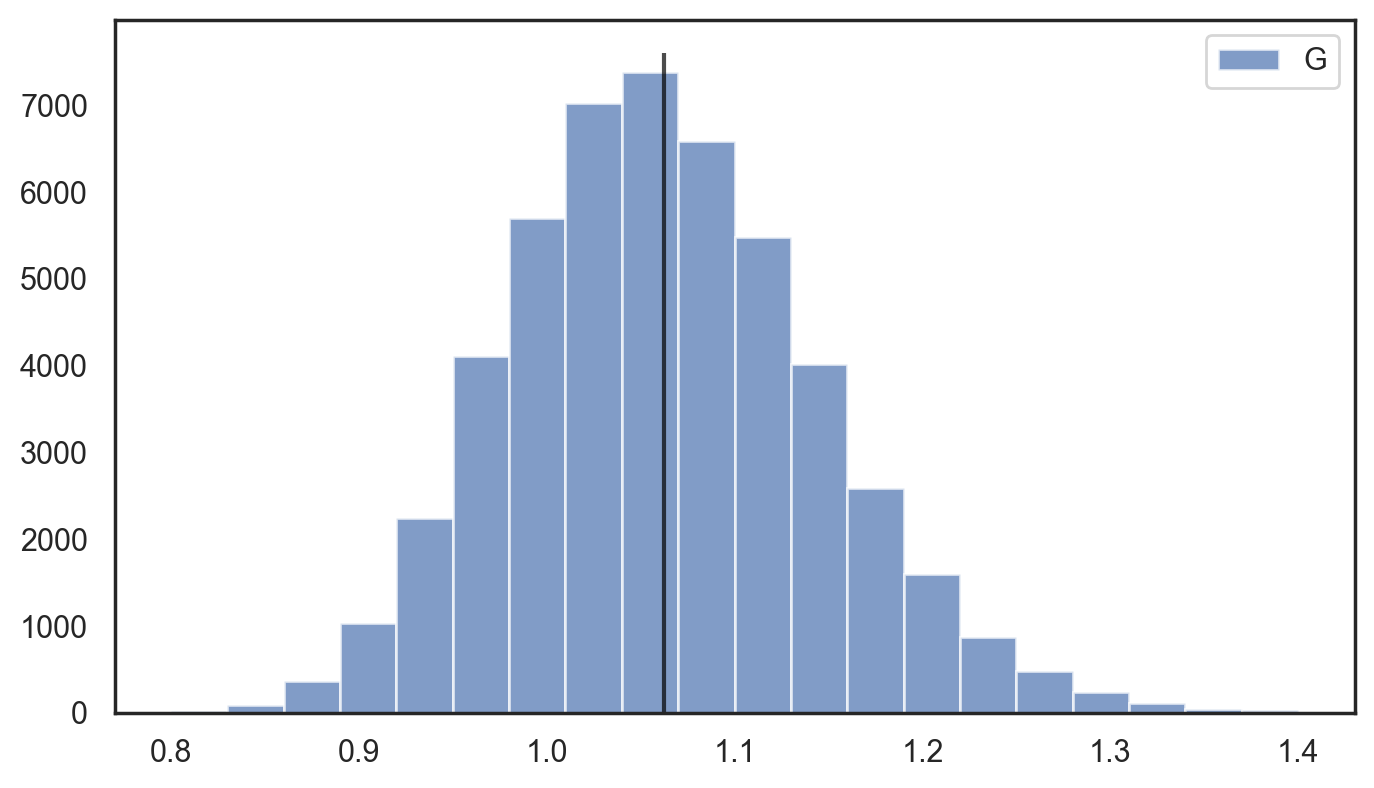
    represented by $\alpha = [1/4, 1/4, 1/4, 1/4]$. The figure below shows the distribution of the relative growth $G$
    after one year.
</p>

<figure>
    <img src='https://raw.githubusercontent.com/ImScientist/ImScientist.github.io/master/assets/blog_content/asset_reallocation/portfolio_growth_uniform_alloc_4dim.png'
         alt="Trajectories of a stochastic process">
    <figcaption>
        Distribution of the relative growth $G$ after one year for the strategy $\alpha = [1/4, 1/4, 1/4, 1/4]$. The
        black solid line refers to the mean value of $G$.
    </figcaption>
</figure>

<p>
    As expected, the mean relative return $\mathbb{E}[G]=1.062$ and the standard deviation $STD[G]=0.082$ fall within
    the expected ranges defined in \eqref{eq:g_inequalities}, with a $5\%$ and $10\%$ chance of the growth being below
    $93.6\%$ and $96.1\%$, respectively.
</p>

<h5>3.2 Arbitrary 4-step reallocation strategies</h5>

<p>
    The example $\alpha = [1/4, 1/4, 1/4, 1/4]$ is just one of countless reallocation strategies. We use a Dirichlet
    distribution to randomly generate other $\alpha$ strategies and calculate the mean, standard deviation, and
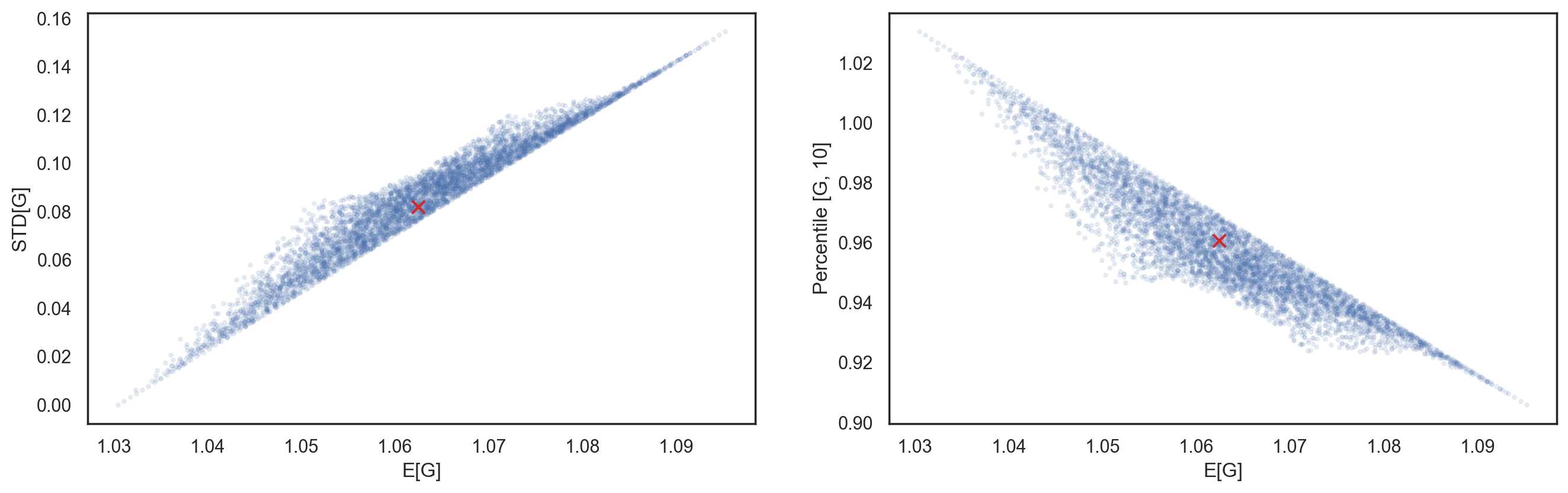
    percentiles of the corresponding relative growth $G$. Results from $10,000$ strategies are plotted below.
</p>

<figure>
    <img src='https://raw.githubusercontent.com/ImScientist/ImScientist.github.io/master/assets/blog_content/asset_reallocation/portfolio_growth_4dim_strategies.png'
         alt="Trajectories of a stochastic process">
    <figcaption>
        Left: Compare the std with the mean of the relative growth $G$ for different 4-step reallocation strategies.
        Right: compare the 10th percentile with the mean of $G$. The red cross is the result of the uniform reallocation
        strategy.
    </figcaption>
</figure>

<p>
    If we look at a vertical stripe of the left figure there will be many strategies with the same mean relative growth
    $G$ but with different std. For instance, at $\mathbb{E}[G] \approx 1.06$, some strategies have significantly lower
    standard deviations than the uniform strategy (marked by a red cross). We are interested in the subset that has the
    lowest $STD[G]$ given $\mathbb{E}[G]$. Based on the numerical results, all these optimal strategies follow the
    pattern:
</p>

\begin{align*}
\alpha & = [c, \,\,\, 0, \,\,\, 0, \,\,\, 1-c] \hspace{7.0mm}  0 \le c \le 1
\end{align*}

<p>
    indicating reallocations occur only at the beginning and end of the year, with no action in the 4th and 8th months.
</p>

<p>
    Similarly, when examining the 10th percentile of $G$ instead of $STD[G]$, the same pattern emerges for the optimal
    strategies.
</p>

<h5>3.3 Arbitrary m-step reallocation strategies</h5>

<p>
    We can extend the experiment to arbitrary $m$-step reallocation strategies. For instance, we analyzed 7-step and
    13-step strategies, corresponding to selling $B$ and buying $S$ every two months and every month, respectively. In
    both scenarios, the optimal strategy takes the form:
</p>

\begin{align*}
\alpha & = [c, \,\,\, 0 \,\,\, \ldots \,\,\, 0, \,\,\, 1-c] \hspace{7.0mm}  0 \le c \le 1
\end{align*}

<p>
    We expect to see the same results for any other $m$-step strategy.
</p>

<h3>4. Summary</h3>

<p>
    This article explores optimal strategies for reallocating assets from a risk-free asset class to a risky one with
    higher returns. It uses stochastic modeling, specifically Geometric Brownian motion, to analyze the time evolution
    of assets and compare different reallocation approaches. By simulating various strategies, it identifies the optimal
    allocation that balances return and volatility. The study finds that reallocating assets only at the beginning and
    end of the investment period minimizes risk while maximizing return potential.
</p>

<h3>Appendix</h3>

<p></p>

<h5>Drawing samples from G</h5>

<p>
    We can reformulate the equation for relative growth $G$ from the first section as follows:
</p>

\begin{align*}
G & = \sum^{N}_{n=0} \alpha_n   \frac{ B(n \, \Delta T) }{ B(0) }  \frac{ S(N \, \Delta T) }{ S(n \, \Delta T ) } \\
& = \sum^{N}_{n=0} \alpha_n   \exp( r \, n \, \Delta T )  \exp \left(  \log \left( \frac{S(N \, \Delta T) }{ S(0) } \frac{S(0) }{ S(n \, \Delta T) } \right) \right) \\
& = \sum^{N}_{n=0} \alpha_n   \exp( r \, n \, \Delta T )  \exp \left(
\log \left( \frac{ S(N \, \Delta T) }{ S(0) } \right) -
\log \left( \frac{ S(n \, \Delta T) }{ S(0) } \right)
\right)
\end{align*}

<p>
    Instead of drawing samples from the process $S_t$ we use the transformed process $X_t = log(S_t/S_0)$, known as
    Arithmetic Brownian Motion:
</p>

\begin{align*}
X_t & =  (\mu - \sigma^2 / 2) \, t + \sigma \, W_t  \hspace{8.0mm} X_0 = 0 \\
dX_t & =  (\mu - \sigma^2 / 2) \, dt + \sigma \, dW_t
\end{align*}

<p>
    To sample a trajectory of $X_t$ we use the Euler-Maruyama method with a small step size $\delta t$:
</p>

\begin{align*}
X(t + \delta t) & = X(t) + (\mu - \sigma^2/2) \, \delta t + \sigma \, \sqrt{\delta t} \,\, \xi_t
\hspace{8.0mm} \xi_t \sim \mathcal{N}(0, 1)
\end{align*}

<p>
    where $\xi_t$ are independent normally distributed random variables sampled at every step. Typically, we have to use
    a very small step $\delta t$ to move forward in time. Since the drift $(\mu-\sigma/2)$ and diffusion $(\sigma)$
    terms of the SDE are constants we can work with arbitrarily large $\delta t $. To demonstrate, consider moving from
    $t_0$ to $t_1$ in $N'$ steps. The step $\delta t =(t_1-t_0)/N'$ can become arbitrarily small for large $N'$:
</p>

\begin{align*}
X(t_0 + \delta t) & = X(t_0) + (\mu - \sigma^2/2) \, \delta t + \sigma \, \sqrt{\delta t} \,\, \xi_1 \\
X(t_0 + 2\delta t) & = X(t_0 + \delta t) + (\mu - \sigma^2/2) \, \delta t + \sigma \, \sqrt{\delta t} \,\, \xi_2 \\
& = X(t_0) + (\mu - \sigma^2/2) \, 2 \, \delta t + \sigma \, \sqrt{\delta t} \,\, (\xi_1 + \xi_2) \\
& \vdots \\
X(t_0 + N'\delta t) & = X(t_0) + (\mu - \sigma^2/2) \, N' \, \delta t + \sigma \, \sqrt{\delta t} \,\, (\xi_1 + \ldots + \xi_{N'})
\end{align*}

<p>
    The sum in the last line $\xi_0 + \xi_1 + \ldots $ forms a normally distributed random variable with zero mean and
    variance $N'$, which can be reparametrized as $\sqrt{N'}· \varepsilon$, where $\varepsilon \sim \mathcal{N}(0, 1)$.
    If we use this expression in the last line of the previous equation we get:
</p>

\begin{align*}
X(t_1) & = X(t_0) + (\mu - \sigma^2/2) \, (t_1 - t_0) + \sigma \, \sqrt{t_1 - t_0} \,\, \varepsilon \hspace{8.0mm} \varepsilon \sim \mathcal{N}(0, 1)
\end{align*}

<p>
    This formula allows us to sample $X_t$ at the time ordered points $(t_0, t_1, t_2 \ldots) = (0, \Delta T, 2 \Delta
    T \ldots)$. From each sampled $X$-trajectory we can compute $G$:
</p>

\begin{align*}
G & = \sum^{N}_{n=0} \alpha_n   \exp \big( r \, n \, \Delta T \big)  \exp \big(
X(N\Delta T)  -  X(n\Delta T)
\big)
\end{align*}

<p>
    The code to generate samples of the Arithmetic Brownian Motion is provided below:
</p>

<script src="https://gist.github.com/ImScientist/d9600697667b94919a18e70d21b5b4e1.js"></script>]]></content><author><name>ImScientist</name></author><summary type="html"><![CDATA[Investigate strategies for reallocating investments from a risk-free asset class to a risky class. This article uses stochastic modeling, including Geometric Brownian motion, to analyze portfolio growth, balancing returns and volatility.]]></summary><media:thumbnail xmlns:media="http://search.yahoo.com/mrss/" url="https://raw.githubusercontent.com/ImScientist/ImScientist.github.io/master/assets/blog_content/asset_reallocation/thumbnail.jpg" /><media:content medium="image" url="https://raw.githubusercontent.com/ImScientist/ImScientist.github.io/master/assets/blog_content/asset_reallocation/thumbnail.jpg" xmlns:media="http://search.yahoo.com/mrss/" /></entry><entry><title type="html">Efficient Likelihood Function Reparametrization for Regression against Categorical Variables</title><link href="https://imscientist.dev/2023/12/01/regression-categorical/" rel="alternate" type="text/html" title="Efficient Likelihood Function Reparametrization for Regression against Categorical Variables" /><published>2023-12-01T00:00:00+00:00</published><updated>2023-12-01T00:00:00+00:00</updated><id>https://imscientist.dev/2023/12/01/regression-categorical</id><content type="html" xml:base="https://imscientist.dev/2023/12/01/regression-categorical/"><![CDATA[<h3>Table of Contents</h3>
<p>
<ol class="toc-list">
  <li>
    <a href="#problem_definition">
      <span class="title">Problem definition</span>
    </a>
  </li>
  <li>
    <a href="#likelihood_simplifacation">
      <span class="title">Simplification of the likelihood function</span>
    </a>
  </li>
  <li>
    <a href="#example">
      <span class="title">Example</span>
    </a>
    <ul>
    <li><a href="#ex_standard_solution">3.1 Standard solution</a></li>
    <li><a href="#reparametrized_likelihood">3.2 Solution with reparametrized likelihood</a></li>
    <li><a href="#scaling">3.3 Scaling of both approaches</a></li>
    </ul>
  </li>
  <li>
    <a href="#references">
      <span class="title">References</span>
    </a>
  </li>
</ol>
</p>

<p>
Employing a Variational Inference approach, we perform regression on a continuous variable
$Y$ and its associated uncertainty, denoted by $STD[Y]$, utilizing a set
of categorical features.
Given the potential magnitude of the dataset, consisting of millions of events, we simplify the
likelihood function of the model to enhance numerical stability and accelerate solutions.
The implementation of this solution with Tensorflow Probability is available in the
dedicated <a href="https://github.com/ImScientist/ilovetfp">Github repository</a> and
<a href="https://colab.research.google.com/drive/11c8W9Sy3GleRkK7d6xs081Tv3tnYafhf?usp=sharing">
Colab notebook</a>.
</p>

<h3 id="problem_definition">1. Problem definition</h3>

<p>
Let’s examine the task of utilizing $M$ categorical features to forecast both the mean value and
standard deviation of a target variable $Y$. A straightforward approach involves employing a linear
function (augmented by an <i>exponential</i> or <i>softplus</i> link function for the non-negative standard
deviation) to model both target variables. Upon applying one-hot encoding to each feature and
transforming them into vectors with dimensions equal to the cardinality of the respective
features, we can characterize them as follows:
</p>

\begin{align}
\label{eq:regr_1a}
f(x, b) & = \sum^{M-1}_{u=0} \vec{b}_u \cdot \vec{x}_u, \\
\label{eq:regr_1b}
g(x, a) & = \text{softplus} \left( \sum^{M-1}_{u=0} \vec{a}_u \cdot \vec{x}_u \right)
\end{align}

<p>
where $f$ models the mean, $g$ — the standard deviation, $x_u$ — the one-hot encoded feature $u$,
and $a_u$, $b_u$ — the yet to be learned weights.
</p>

<p>
The priors of the individual elements $b_{uv}$ in \eqref{eq:regr_1a} (1a) are characterized by normal
distributions $\rho (b_{uv} | 0, \lambda^2_{uv})$ with a mean of zero and a standard deviation of
$\lambda_{uv}$. To ensure positivity, $\lambda_{uv}$ is drawn from a Gamma distribution,
$\Gamma(\lambda_{uv}| \alpha, \beta)$, where $\alpha$ is the shape parameter and $\beta$ is the rate,
both constants. The priors for the weights $\alpha_{uv}$ in \eqref{eq:regr_1b} are established in an
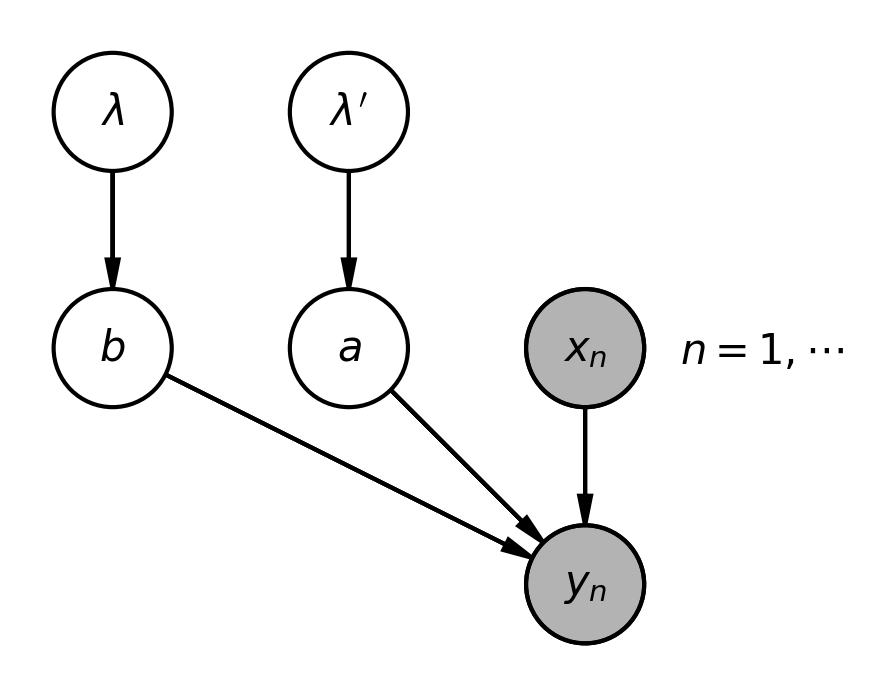
identical manner. For a comprehensive overview of the introduced variables and their interdependencies,
refer to the figure below.
</p>

<figure>
    <img src='https://raw.githubusercontent.com/ImScientist/ImScientist.github.io/master/assets/blog_content/regression_likelihood/pgm.png' alt="graphical model" >
    <figcaption>The Probabilistic graphical model of our problem</figcaption>
</figure>

\begin{align}
\label{eq:likelihood}
P(\lambda) \, P(\lambda') \, P(b | \lambda ) \, P(a | \lambda' ) \, P(y | x, a, b) &
\end{align}

<p>
Let’s delve into the precise mathematical definitions of each term. The section on the left side
of the graph, featuring the $\lambda$ and $b$ symbols, represents the prior distribution for the
weights $b_{uv}$:
</p>

\begin{align}
P(b | \lambda )P(\lambda)
& = \prod^{M-1}_{u=0} \prod_{v} P(b_{uv} | \lambda_{uv})P(\lambda_{uv}) \nonumber \\
& = \prod^{M-1}_{u=0} \prod_{v} \rho \left(b_{uv} | 0, \lambda^2_{uv} \right) \gamma( \lambda_{uv} | \alpha_0, \beta_0),
\hspace{5mm} \alpha_0= \beta_0 = 0.001
\end{align}

<p>
The central portion refers to the priors of the $a_{uv}$ weights, and as previously noted,
they are described in an identical manner as the $b_{uv}$ weights: a simple substitution
of $b$ with $a$ and $\lambda$ with $\lambda'$ suffices.
</p>

<p>
Concluding the graph is the segment dedicated to the likelihood function, $P(y| x, a, b)$,
modeled as the product of normal distributions $\rho(y| \mu, \sigma^2)$ for each data point $(x, y)$.
Here, $\mu$ is determined by the function $f(x,b)$ in \eqref{eq:regr_1a}, and
$\sigma$ is determined by $g(x,a)$ in \eqref{eq:regr_1b}.
</p>

<h3 id="likelihood_simplifacation">2. Simplification of the likelihood function</h3>

<p>
With Tensorflow Probability, defining the joint-probability distribution function and its
log-probability is straightforward, and the application of the variational inference approach
is exemplified in the subsequent section.
</p>

<p>
Unfortunately, this implementation experiences escalating convergence times as the
dataset size grows. To mitigate computational demands, a time-saving strategy involves
simplifying the log-likelihood expression. Subsequently, we can substitute the original
likelihood distribution in the solution with a newly devised custom distribution object
housing the adjusted log-likelihood expression.
</p>

<p>
When dealing with only $M$ categorical features, the data points in the training dataset
can be organized into a finite number of groups. Each group corresponds to a unique
combination of values that the categorical features can take. The total number of
groups, $N$, is equal to or less than the product of the cardinalities of the features.
For example, if we have a categorical feature that can take $2$ unique values and
another one that can take $4$ unique values, the total number of groups should be $8$.
Here, the index $i$ denotes the group, and $j$ represents an index within that group.
All observations can be expressed as $\{ (y^{(ij)}, x^{(ij)}) | i = 1, \ldots N,
j = 1, \ldots N_i \}$,
where $N_i$ denotes the number of elements in group $i$, and $x^{(ij)}$ refers to all
categorical features of observation $(ij)$. Since all elements within the same
group $i$ share identical categorical features, we can simplify $x^{(ij)}$ to $x^{(i)}$.
</p>

<p>
The likelihood function in \eqref{eq:likelihood} could be rewritten in the following form:
</p>

\begin{align*}
P(y|x, a, b)  & = \prod^{N}_{i=1} \prod^{N_i}_{j=1}  \rho \left( y^{(ij)} \Big| f(x^{(ij)},  b),  g^2(x^{(ij)}, a) \right)  \\
& \propto  \exp \left[ -\frac{1}{2} \sum^{N}_{i=1} \sum^{N_i}_{j=1} \frac{ \left( y^{(ij)} - f(x^{(ij)}, b) \right)^2 }{ g^2(x^{(ij)}, a) } \right] \\
& \propto \exp \left[
-\frac{1}{2} \sum^{N}_{i=1} \frac{N_i}{ g^2(x^{(i)}, a) }
\bigg( f^2(x^{(i)}, b) - 2 \cdot f(x^{(i)}, b) \cdot \mathbb{E}\left[y^{(i)}\right] + \mathbb{E}\left[y^{(i)2}\right] \bigg) \right] \\
& \propto \exp \left[
-\frac{1}{2} \sum^{N}_{i=1} \frac{N_i}{ g^2(x^{(i)}, a) } \bigg(
\big( f(x^{(i)}, b) - \mathbb{E}\left[y^{(i)}\right] \big)^2
+ \underbrace{ \mathbb{E}\left[y^{(i)2}\right] - \mathbb{E}\left[y^{(i)}\right]^2 }_{ STD \left(y^{(i)} \right)^2 }
\bigg) \right] \\
\mathbb{E}\left[y^{(i)}\right] & \equiv \frac{1}{N_i} \sum^{N_i}_{j=1} y^{(ij)} \\
\mathbb{E}\left[y^{(i)2}\right]  & \equiv \frac{1}{N_i} \sum^{N_i}_{j=1} y^{(ij)2}
\end{align*}

<p>
The last line of the equation was derived by adding and subtracting $\mathbb{E} [y^{(i)}]^2$ and
regrouping the terms.
</p>

<p>
The derivation of the log-probability for both the likelihood component and the complete
joint-probability distribution function \eqref{eq:likelihood} is straightforward. All summations involved
are solely over the $N$ distinct groups. Within each group, the observed target values
$y^{(ij)}$ are replaced with the group mean, $\mathbb{E}[y^{(i)}]$, and standard deviation, $STD[y^{(i)}]$.
The resulting number of elements $N$ is considerably smaller than the total count of
original observations $\sum_i N_i$.
</p>

<h3 id="example">3. Example</h3>

<p>
We explore a scenario of having a target variable $Y$ whose mean and standard deviation
can be linearly regressed by two categorical variables $f0$, $f1$ with cardinalities
of $2$ and $4$, respectively (and with a <i>softplus</i> link function applied to the
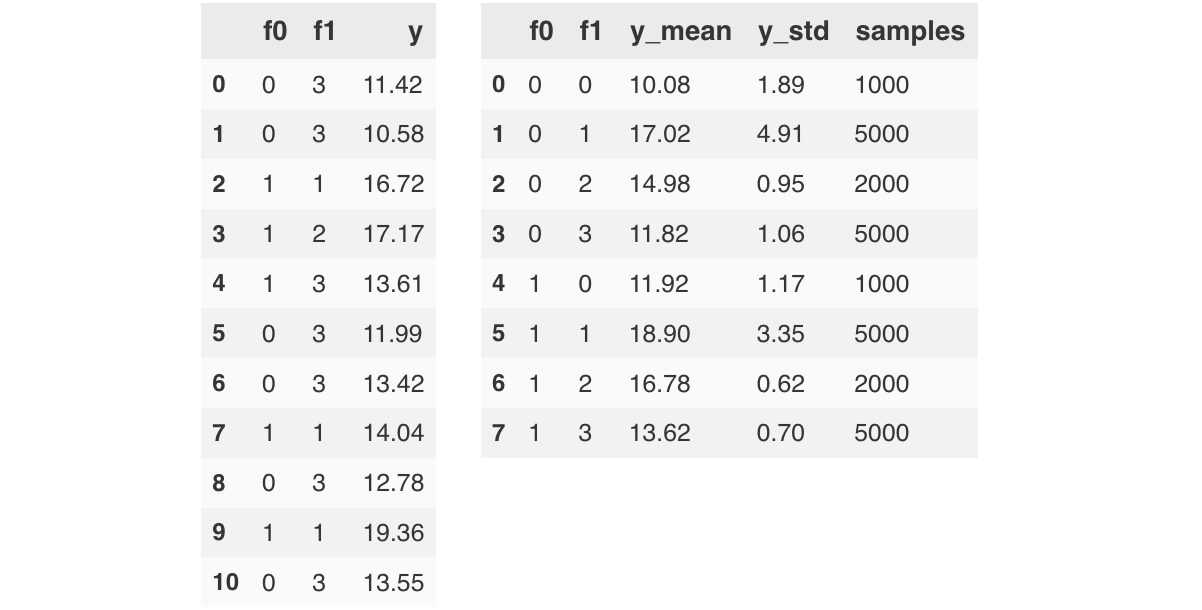
standard deviation). The figure below provides a sample of the generated data:
</p>

<figure>
    <img src='https://raw.githubusercontent.com/ImScientist/ImScientist.github.io/master/assets/blog_content/regression_likelihood/data_sample.png' alt="data sample" >
    <figcaption>Data samples (left) and target mean and standard deviation for all groups (right)</figcaption>
</figure>

<h5 id="ex_standard_solution">3.1 Standard solution</h5>

<p>
To build the model (the joint probability distribution in \eqref{eq:likelihood}) we can use the
code snippet below:
</p>

<script src="https://gist.github.com/ImScientist/526b24e5d8ae7f6f30fdcbc9ae984da9.js"></script>

<p>
Since we are using the Variational inference approach to solve the problem,
we have to construct a surrogate posterior for $\lambda_{uv}$, $\lambda'_{uv}$, $a_{uv}$, $b_{uv}$,
as well.
For simplicity, we assume that that there are no correlations between the variables.
This reduces the posterior description to the product of univariate distributions
of the normally distributed weights $a_{uv}$, $b_{uv}$ and log-normally distributed $\lambda_{uv}$,
$\lambda'_{uv}$.
</p>

<script src="https://gist.github.com/ImScientist/119a1e8bf2a9882a3400f5a312a68618.js"></script>

<p>
The code snippet below demonstrates how the model is trained with (<code>method=aggregated</code>)
and without (<code>method=standard</code>) the likelihood simplification. Between the two approaches
there are almost no differences, except the use of <code>build_model_agg_data()</code>
and <code>build_model()</code> to construct the likelihoods, and the different input data.
</p>

<p>
<script src="https://gist.github.com/ImScientist/46289b32d71d585219085009ae4c2704.js"></script>
</p>

<h5 id="reparametrized_likelihood">3.2 Solution with modified likelihood</h5>

<p>
We can use the same definition of the priors and the surrogate posteriors from
the previous solution. The only difficulty is plugging in the new likelihood
function into the joint distribution. To achieve this we create a new class
derived from the standard <code>AutoCompositeTensorDistribtuion</code> Tensorflow class.
We are interested only in the <code>log_prob()</code> method of this class. The method to
sample values from the distribution is defined only because Tensorflow uses it
to infer the right dimensions of the sampled values (so it is fine if we define
it to return only zeros).
</p>

<script src="https://gist.github.com/ImScientist/d4cdc3496e4219f58d2b47141c684840.js"></script>

<p>
The model (joint probability distribution) is build similarly to the model from the standard solution:
</p>

<p>
<script src="https://gist.github.com/ImScientist/977182673d1329d770783df52255d369.js"></script>
</p>

<h5 id="scaling">3.3 Scaling of both approaches</h5>

<p>
One can use this
<a href="https://colab.research.google.com/drive/1jmL8VxfiAKbtVAtUvAex6Wi9-a8zrGCe?usp=sharing">Colab-notebook</a>
to check if the predicted mean and standard deviation of the target variable for
all feature combinations between both models are the same. By increasing the
dataset size one can see that the computation time of the solution employing
the modified likelihood is constant. On the other hand the computation time
of the standard solution significantly increases.
</p>

<h3 id="references">4. References</h3>

<p>
<ul>
  <li>
    Source code:
    <a href="https://github.com/ImScientist/ilovetfp">https://github.com/ImScientist/ilovetfp</a>
  </li>
  <li>
    Colab notebook:
    <a href="https://colab.research.google.com/drive/11c8W9Sy3GleRkK7d6xs081Tv3tnYafhf?usp=sharing"
    >https://colab.research.google.com/drive/11c8W9Sy3GleRkK7d6xs081Tv3tnYafhf?usp=sharing</a>
  </li>
</ul>
</p>]]></content><author><name>ImScientist</name></author><summary type="html"><![CDATA[We simplify the likelihood function obtained when regressing on categorical variables. This speeds up the variational inference implementation in tensorflow.]]></summary><media:thumbnail xmlns:media="http://search.yahoo.com/mrss/" url="https://raw.githubusercontent.com/ImScientist/ImScientist.github.io/master/assets/blog_content/regression_likelihood/cover.png" /><media:content medium="image" url="https://raw.githubusercontent.com/ImScientist/ImScientist.github.io/master/assets/blog_content/regression_likelihood/cover.png" xmlns:media="http://search.yahoo.com/mrss/" /></entry><entry><title type="html">Monitor deployed tensorflow models with Prometheus and Grafana</title><link href="https://imscientist.dev/2023/11/01/model-serving/" rel="alternate" type="text/html" title="Monitor deployed tensorflow models with Prometheus and Grafana" /><published>2023-11-01T00:00:00+00:00</published><updated>2023-11-01T00:00:00+00:00</updated><id>https://imscientist.dev/2023/11/01/model-serving</id><content type="html" xml:base="https://imscientist.dev/2023/11/01/model-serving/"><![CDATA[<p>
We provide a minimal example how to serve tensorflow models on a Kubernetes cluster and monitor them with
Prometheus and Grafana. To expose the models we create a deployment and service manifests, whereas for the
deployment of Prometheus and Grafana we use the corresponding helm charts provided by
<a href="https://github.com/bitnami/charts">bitnami</a>. We also briefly
explain the process of transforming a tensorflow model into a servable. The full code can be found in this
<a href="https://github.com/ImScientist/tensorflow-serving">Github repository</a>.
</p>

<h3>Table of Contents</h3>
<p>
<ol class="toc-list">
    <li>
        <a href="#creating_models">
            <span class="title">Creating and exposing tf models as REST APIs</span>
        </a>
    </li>
    <li>
        <a href="#kubernetes">
            <span class="title">Kubernetes deployment</span>
        </a>
        <ul>
            <li><a href="#k8s_tf_serving">2.1 Tensorflow serving</a></li>
            <li><a href="#k8s_prometheus">2.2 Prometheus</a></li>
            <li><a href="#k8s_grafana">2.3 Grafana</a></li>
        </ul>
    </li>
    <li>
        <a href="#references">
            <span class="title">References</span>
        </a>
    </li>
</ol>
</p>

<h3 id="creating_models">1. Creating and exposing tf models as REST APIs</h3>

<p>
To keep things simple we use trivial models, like <code>f(x)=x/2+2</code> but the idea can be applied to any
subclass of <code>tf.Module</code> that has the <code>.save()</code> method. A minimal example is provided
below:
</p>

<script src="https://gist.github.com/ImScientist/54be5f23c598a9ca0b395e11b32c1573.js"></script>

<p>
In the directory where the model is saved you can find a <code>saved_model.pb</code> file. It stores the
TensorFlow model, and a set of named signatures, each identifying a function that accepts tensor inputs and
produces tensor outputs. Whereas tf.Keras models automatically specify serving signatures, for custom modules
you have to declare them explicitly, as described
<a href="https://www.tensorflow.org/guide/saved_model#specifying_signatures_during_export">here</a>. To get an
overview of the available signatures you can use the <code>saved_models_cli</code> in your cli. Usually, you
will only have and need the <code>serving_default</code> signature. For the example presented above you can
obtain the inputs and outputs of the <code>serving_default</code> signature with the following command:
</p>

<script src="https://gist.github.com/ImScientist/99e7202db843b704bcb26dd7282e69ef.js"></script>

<p>
As a next step, we use the official <code>tensorflow/serving</code>
<a href="https://hub.docker.com/r/tensorflow/serving">image</a> to expose the saved models as a REST API (you
can use the same image to make grpc calls against the models but this won’t be covered here). An example, how
to run the container, mount the saved model (assuming that it is stored in <code>$(pwd)/models</code>), and
make a REST call is provided below:
</p>

<script src="https://gist.github.com/ImScientist/7ef3fcda9d970ca0c63ef999c836bdb7.js"></script>

<p>
In this example we made 3 predictions of <code>f(x)=x/2+2</code> for x=0,1,2. Note that in the POST request we
had to specify the signature name <code>serving_default</code> and to make the input data compliant with the
signature definition.
</p>

<p>
To serve multiple models we do not only have to mount them in the image but also have to specify a config file
that maps the model location to a service path. For example, if we have 3 models mounted in the
<code>/models</code> directory, as described below,
</p>

<script src="https://gist.github.com/ImScientist/f70d38b3e12137b7fd9ec53857695eee.js"></script>

<p>
we can use the following configuration (mounted in <code>/models/models.config</code>):
</p>

<script src="https://gist.github.com/ImScientist/479df553f620da38721d9a6b27de1022.js"></script>

<p>
You can copy the content in <code>/models</code> from
<a href="https://github.com/ImScientist/tensorflow-serving/tree/master/models">here</a>. To start the service
we will use the same <code>tensorflow/serving</code> image but with few extra arguments:
</p>

<script src="https://gist.github.com/ImScientist/ebd9d85e7c04fafce68f2357e929a6a7.js"></script>

<p>
<ul>
  <li>The <code>model_config_file_poll_wait_seconds</code> flag instructs Tensorflow Serving to periodically
  poll for updated versions of the configuration file specified by the <code>model_config_file</code>
  flag.
  <br/><br/>
  </li>

  <li>The <code>version_labels</code> section of the config file allows us to map different model versions to
  the same
  endpoint. In this example, calling the endpoints <code>/half_plus_ten/labels/stable</code> and
  <code>/half_plus_ten/labels/canary</code> is equivalent to calling <code>/half_plus_ten/versions/1</code>
  and <code>/half_plus_ten/versions/2</code>, respectively.
  <br/><br/>
  </li>

  <li>The <code>allow_version_labels_for_unavailable_models</code> flag allows us to assign a label to a
  version that is not yet loaded.
  <br/><br/>
  </li>
</ul>
</p>

<p>
In this example the following service calls are possible (you can pick each one of the three
<code>MODEL_PATH</code> by commenting out the other two):
</p>

<script src="https://gist.github.com/ImScientist/b993452abde754455b1efb2c020e4e56.js"></script>

<h3 id="kubernetes">2. Kubernetes deployment</h3>
<p>
For simplicity, we use a Kubernetes cluster deployed on a local machine. This prevents us, for example,
to simulate exactly how the new tensorflow models are mounted and served but all other configurations
presented below can be used for the cloud deployment.
</p>

<p>
To reproduce the steps listed below, you need a local Kubernetes installation, like
<a href="https://www.docker.com/products/docker-desktop/">Docker Desktop</a> or
<a href="https://rancherdesktop.io/">Rancher Desktop</a>, and the
<a href="https://helm.sh/docs/intro/install/">helm</a> package manager that automates the deployment of
software for Kubernetes.
</p>

<h5 id="k8s_tf_serving">2.1 Tensorflow serving</h5>

<p>
We create a single deployment that is exposed to the other components in the cluster through a service. In the
ideal case, the exported models should be made available to the tf-server pods by mounting them as volumes.
Instead, the pods in the deployment will be running containers that already contain the models. The Dockerfile
that creates them is given below:
</p>

<script src="https://gist.github.com/ImScientist/3f905a95cc6d3cce6908c50e2982363d.js"></script>

<p>
We can create the container, the kubernetes namespace, deployment and service with the following commands:
</p>

<script src="https://gist.github.com/ImScientist/57f1ca847fb368f719fe2e8dcaf2fcdd.js"></script>

<p>
where the content of <code>tf-serving.yaml</code> is given below:
</p>

<script src="https://gist.github.com/ImScientist/418bb9571621a27b7b891d67a1eb4bd1.js"></script>

<p>
In <a href="https://github.com/ImScientist/tensorflow-serving">this repository</a> you can also find the
corresponding helm chart. From the yaml file we can see that:

<ul>
  <li>
    We are pulling the locally stored tensorflow server image by setting <code>pullPolicy: Never</code>
    (line 21). This line should be changed if we are using a cluster on the cloud (in addition to pushing the
    <code>tf-server:1.0.0</code> image to a container registry).
    <br/><br/>
  </li>

  <li>
    We provide a monitoring configuration to the server by using the <code>rest_api_port</code> flag and
    the <code>monitoring_config_file</code> flag (line 24, 27). The latter flag points to the
    <code>/models/monitoring.config</code> file that has the following content:
    <br/><br/>

    <script src="https://gist.github.com/ImScientist/e846b58e122a0e5b33ee60e12d34b30a.js"></script>
  </li>

  <li>
  All metrics that can be scraped by Prometheus are accessible at path
  <code>/monitoring/prometheus/metrics</code> and port 8501. You can see them by browsing to
  <code>http://localhost:8501/monitoring/prometheus/metrics</code>.
  <br/><br/>
  </li>

  <li>
    We are using a service of type <code>LoadBalancer</code> (line 42). If the service is intended to be used
    only by other components in the same cluster then we could change the type of the service to
    <code>ClusterIP</code>. We should be able to make API calls to the service in the same way as we did in
    the previous section.
    <br/><br/>
  </li>

</ul>
</p>

<h5 id="k8s_prometheus">2.2 Prometheus</h5>

<p>
We will use helm to install all Prometheus components. Since it provides us with a working application out of
the box we do not have change its default settings. We only have to provide the instructions how to discover
the pods of the Model Server and extract information from them. We can do this by:

<ul>
  <li>
    storing the configurations as a secret in the same namespace where Prometheus is deployed and providing
    the secret name and key to Prometheus.
    <br/><br/>
  </li>

  <li>
    defining the configurations to be managed by the Helm. In this case a change of the configurations
    requires a new release version.
    <br/><br/>
  </li>
</ul>


More information can be found in the official documentation. We will use the second option. The configuration
that we are using is stored as prometheus_helm.yaml:

</p>

<script src="https://gist.github.com/ImScientist/38fe7640071b852787b9347aebb82dc8.js"></script>

<p>
It defines a scrape job that looks for pods with the label <code>app: tf-serving</code> (line 13) in the
<code>tfmodels</code> namespace (line 17) and every 5s it checks for new data by calling
<code>/monitoring/prometheus/metrics</code> on port 8501. To install all Prometheus components execute:
</p>

<script src="https://gist.github.com/ImScientist/004c296aa173e64ca174da28c46f97ab.js"></script>

<p>
You should get a message telling you under which DNS from within the cluster Prometheus can be accessed.
</p>

<script src="https://gist.github.com/ImScientist/7628a4f8c88169b6b250d39f00bc9a8c.js"></script>

<p>
To access Prometheus from outside the cluster execute:
<code>kubectl -n monitoring port-forward svc/<service name> 9090:9090</code> (the service name is obtained
from the panel above). After few minutes when all Prometheus components are installed you can access the
Prometheus UI at <code>http://127.0.0.1:9090</code>. You can execute the query
<code>:tensorflow:serving:request_count</code> and check how the graph changes after making several API calls
to the tf model service.
</p>

<figure>
    <img src='https://raw.githubusercontent.com/ImScientist/ImScientist.github.io/master/assets/blog_content/ml_monitoring/prometheus_ui.png' alt="prometheus_ui" >
</figure>


<h5 id="k8s_grafana">2.3 Grafana</h5>

<p>
We will use helm to install Grafana. No additional configurations are required:
</p>

<script src="https://gist.github.com/ImScientist/15b4f03b6e8ae260caacb8dfb9b9d946.js"></script>

<p>
You should automatically get the following instructions how to access the Grafana dashboard
(note that in the panel below the kubectl namespace flag is skipped; you should not skip it):
</p>

<script src="https://gist.github.com/ImScientist/5b76ebe2548f502cf0f2d6c5e4fc205c.js"></script>

<p>
To access Grafana from outside the cluster execute
<code>kubectl -n monitoring port-forward svc/grafana-chart 8080:3000</code> and browse to
<code>http://127.0.0.1:8080</code> to access the service. You can add Prometheus as a datasource
by using the previously obtained prometheus DNS name as a datasource URL:
<code>http://<service name>.monitoring.svc.cluster.local:9090</code>
</p>

<figure>
    <img src='https://raw.githubusercontent.com/ImScientist/ImScientist.github.io/master/assets/blog_content/ml_monitoring/grafana_ui.png' alt="grafana_ui" >
</figure>

<p>
Now you should be able to create your first dashboard by using the metric
<code>:tensorflow:serving:request_count</code> and Prometheus as a data source.
</p>

<figure>
    <img src='https://raw.githubusercontent.com/ImScientist/ImScientist.github.io/master/assets/blog_content/ml_monitoring/grafana_dashboard.png' alt="grafana_dashboard" >
</figure>

<p>
To remove all components that you have installed execute:
</p>

<script src="https://gist.github.com/ImScientist/65163dc23bf5385f62d753eb061350e4.js"></script>

<p></p>

<h3 id="references">3. References</h3>

<p>
<ul>
  <li>
    <a href="https://www.tensorflow.org/guide/saved_model#specifying_signatures_during_export">
    Specifying signatures of tf.models during export</a>
  </li>
  <li>
    <a href="https://helm.sh/docs/intro/install/">Helm installation</a>
  </li>
  <li>
    <a href="https://docs.bitnami.com/kubernetes/apps/prometheus-operator/configuration/customize-scrape-configurations/">
    Prometheus scrape configuration</a>
  </li>
  <li>
    <a href="https://github.com/ImScientist/tensorflow-serving">Source code</a>
  </li>
</ul>
</p>]]></content><author><name>ImScientist</name></author><summary type="html"><![CDATA[We provide a minimal example how to serve tensorflow models on a Kubernetes cluster and monitor them with Prometheus and Grafana. To expose the models we create a deployment and service manifests, whereas for the deployment of Prometheus and Grafana…]]></summary><media:thumbnail xmlns:media="http://search.yahoo.com/mrss/" url="https://raw.githubusercontent.com/ImScientist/ImScientist.github.io/master/assets/blog_content/ml_monitoring/ml_monitoring.png" /><media:content medium="image" url="https://raw.githubusercontent.com/ImScientist/ImScientist.github.io/master/assets/blog_content/ml_monitoring/ml_monitoring.png" xmlns:media="http://search.yahoo.com/mrss/" /></entry><entry><title type="html">MLflow on Kubernetes</title><link href="https://imscientist.dev/2023/08/01/mlflow/" rel="alternate" type="text/html" title="MLflow on Kubernetes" /><published>2023-08-01T00:00:00+00:00</published><updated>2023-08-01T00:00:00+00:00</updated><id>https://imscientist.dev/2023/08/01/mlflow</id><content type="html" xml:base="https://imscientist.dev/2023/08/01/mlflow/"><![CDATA[<p>
We will containerize and deploy a MLflow server on a Kubernetes cluster on Google cloud. We will also create the MLflow backend DB, the artifact store and all required service accounts, and secrets on Google cloud. This is achieved by using either gcloud SDK or terraform. The deployment code can be found <a href="https://github.com/ImScientist/mlflow">here</a>.
</p>

<h3>Table of Contents</h3>
<p>
<ol class="toc-list">
    <li>
        <a href="#infrastructure">
            <span class="title">Infrastructure</span>
        </a>
    </li>
    <li>
        <a href="#deployment_sdk">
            <span class="title">Deployment with Google cloud SDK</span>
        </a>
    </li>
    <li>
        <a href="#deployment_terraform">
            <span class="title">Deployment with terraform</span>
        </a>
    </li>
    <li>
        <a href="#resources">
            <span class="title">Resources</span>
        </a>
    </li>
</ol>
</p>

<h3 id="infrastructure">1. Infrastructure</h3>

<p>
We will create the following resources in Google cloud:
<ul>
  <li>Bucket in cloud storage that will be used as artifact storage</li>
  <li>PostreSQL DB in cloud SQL that will be used as mlflow backend db</li>
  <li>Container registry (GCR) that will host our custom mlflow image defined
  <a href="https://github.com/ImScientist/mlflow/tree/master/mlflow_server">here</a> </li>
  <li>Service account (and json-key) with access to GCS and cloud SQL</li>
  <li>Service account (and json-key) with access to GCR (used by the Google node pool to pull images from GCR)</li>
</ul>
</p>

<p>
The kubernetes cluster contains:
<ul>
  <li>Kubernetes Secret that contains credentials of the service account with GCS and SQL access, as well as access to the backend db</li>
  <li>Kuberentes Configmap</li>
  <li>Kubernetes Deployment where each pod holds two containers:</li>
    <ul>
      <li>cloud sql auth proxy container that creates a secure connection to the PostgreSQL DB</li>
      <li>mlflow server that connects to the PostgreSQL DB via the cloud sql auth proxy. We use a custom build image that is defined
      <a href="https://github.com/ImScientist/mlflow/tree/master/mlflow_server">here</a>.</li>
    </ul>
  <li>Kubernetes Service</li>
</ul>
</p>

<h3 id="deployment_sdk">2. Deployment with Google cloud SDK</h3>

<p>
We will rely on the Google cloud SDK to create the resources of interest. To run the commands below you need to have gsutil, gcloud and OpenSSL CLIs installed.

<ul>
  <li>Setup environment variables:
  <script src="https://gist.github.com/ImScientist/4e3809076a33f6f43783f7306a1c46f4.js"></script>
  </li>

  <li>Create the required resources in Google cloud (except the kubernetes cluster):
  <script src="https://gist.github.com/ImScientist/4ce4e6bf1b404ba5d8763ec75819ec0e.js"></script> Unfortunately, I am not able to create a kubernetes cluster with the gcloud sdk so you have to use the UI to create it.
  </li>

  <li>Creation of the Kubernetes cluster components. You have to change the kubectl context: <script src="https://gist.github.com/ImScientist/bcb1b6bc389dd014cd2e09d54e809e13.js"></script>
  There is an option for local deployment with docker-desktop. In this case you have to create a docker-registry secret that porvides access to the container registry with our custom mlflow image: <script src="https://gist.github.com/ImScientist/5ea7933da4d5c62853723cd21901bc97.js"></script>
  The commands for the creation of the remaining components are the same both for the local and for the Google cloud deployment:
  <script src="https://gist.github.com/ImScientist/a030cffd6c9d67a00345cf21dfc1cdd4.js"></script>
  </li>

  <li>Test if everything works: <br>
  To test if the Mflow server is running you can execute the following python code snippet and verify through the mlflow UI that the results are logged. In the experiment definition you will see that we are using the <code>GCS_CREDENTIALS</code> to store the artifacts in GCS. You also have to change the tracking URI.
  <script src="https://gist.github.com/ImScientist/07215003e56e18aa9611c4af31ad1534.js"></script>
  </li>
</ul>
</p>

<h3 id="deployment_terraform">3. Deployment with terraform</h3>
<p>
To understand the following code snippets you should look at the source code provided <a href="https://github.com/ImScientist/mlflow">here</a>.
<ul>
<li>Install the terraform version manager. We will work with version 1.2.7: <script src="https://gist.github.com/ImScientist/b9b548a0dce26ffcf95c77d7bda24fa7.js"></script></li>

<li>Set the <code>project</code>, <code>region</code> and <code>zone</code> in <code>./terrafrom/variables.tf</code> and authenticate: <script src="https://gist.github.com/ImScientist/dc47e70f0db21a09b69c127fd9f34ec4.js"></script>

The following command will create the required infrastructure (backend db, cloud storage, kubernetes cluster and service accounts). It will also create the namespace mlflow and add to it a config-map and a secret with all relevant credentials for the service.<script src="https://gist.github.com/ImScientist/ba13f7378c06e9753acf9c5f7faaafa8.js"></script></li>

<li>To deploy the service, we first have to build a mlflow-server image (content in ./mlflow_server directory) and push it to the container registry in our project. We will use Google cloud build. As a result the image <code>gcr.io/${PROJECT_ID}/mlflow:${TAG_NAME}</code> should be created. <script src="https://gist.github.com/ImScientist/39e619fd1bfd72b7d2e368d8b06ed602.js"></script>
</li>

<li>The remaining components that have to be created are described in <code>kubernetes/mlflow.yaml</code>. We have to change the image of the mlflow-server-container (line 21) to point to the image that we have created in the previous step. We can use kubectl to crete the missing components: <script src="https://gist.github.com/ImScientist/706a958cfabab12e250012034c6c1e0b.js"></script>
</li>
</ul>
</p>


<h3 id="resources">4. Resources</h3>

<ul>
  <li>
  <a href="https://colinwilson.uk/2020/07/09/using-google-container-registry-with-kubernetes/">Using Google Container Registry (GCR) with Kubernetes</a>
  </li>
</ul>]]></content><author><name>ImScientist</name></author><summary type="html"><![CDATA[We will containerize and deploy a MLflow server on a Kubernetes cluster on Google cloud. We will also create the MLflow backend DB, the artifact store and all required service accounts, and secrets on Google cloud. This is achieved by using either…]]></summary><media:thumbnail xmlns:media="http://search.yahoo.com/mrss/" url="https://raw.githubusercontent.com/ImScientist/ImScientist.github.io/master/assets/blog_content/mlflow/mlflow.png" /><media:content medium="image" url="https://raw.githubusercontent.com/ImScientist/ImScientist.github.io/master/assets/blog_content/mlflow/mlflow.png" xmlns:media="http://search.yahoo.com/mrss/" /></entry><entry><title type="html">Bayesian inference for stochastic processes: an analytically solvable problem</title><link href="https://imscientist.dev/2022/03/01/stochastic-processes/" rel="alternate" type="text/html" title="Bayesian inference for stochastic processes: an analytically solvable problem" /><published>2022-03-01T00:00:00+00:00</published><updated>2022-03-01T00:00:00+00:00</updated><id>https://imscientist.dev/2022/03/01/stochastic-processes</id><content type="html" xml:base="https://imscientist.dev/2022/03/01/stochastic-processes/"><![CDATA[<p>
We explain the application of the Bayesian inference approach, described in the
previous blog post, to the case of having multiple trajectories of a stochastic
process. We will consider an analytically solvable problem to address the question
of how much the past values of a trajectory reduce our uncertainty about its future
values. In addition, we will also solve the problem using the MCMC approach,
implemented in the
<a href="https://www.tensorflow.org/probability">Tensorflow probability</a> library,
and compare both results.
</p>

<h3>1. Stochastic processes and State space models</h3>

<p>
A stochastic process can be defined as a collection of random variables $\{Z_t\}$ with
a time index $t$. To obtain some information from it, we often make observations $\{ y_t \}$
at different times that are noisy and deviate from the exact values $\{ z_t \} $. This type
of problem is often described through state-space models where the observations $\{ y_t \}$
are described as samples of an observation process $\{ Y_t \}$ that depend linearly on the
state process $\{ Z_t \}$. A graphical representation of the idea is given in the figure
below:
</p>

<figure>
    <img src='https://raw.githubusercontent.com/ImScientist/ImScientist.github.io/master/assets/blog_content/stoch_process_p1/ssm.png'
     alt="State space model schema" >
    <figcaption> Representation of a state space model: $Z_t \rightarrow Y_t$ means that
     $Y_t$ depends on $Z_t$
    </figcaption>
</figure>

<p>
To make everything more understandable, we will consider the local level model with a
constant drift:
</p>

\begin{align}
Y_t & = Z_t + \varepsilon_t \nonumber \\
\label{eq:loc_level}
Z_t & = Z_{t-1} + \omega + \eta_t, \hspace{4.0mm} Z_0 = 0 \nonumber \\[2.0mm]
\varepsilon_t & \sim \mathcal{N} \left( 0, \sigma^2_y \right), \hspace{10.2mm}
\mathbb{E}\left(\varepsilon_t \varepsilon_{t'}  \right) = 0 \hspace{2.0mm}
\text{for}  \hspace{2.0mm} t \neq t' \nonumber \\
\eta_t & \sim \mathcal{N} \left( 0, \sigma^2_z \right), \hspace{10.2mm}
\mathbb{E}\left(\eta_t \eta_{t'}  \right) = 0  \hspace{2.0mm} \text{for}  \hspace{2.0mm} t \neq t'
\end{align}

<p>
which is constructed with the help of the normally distributed random variables
$\varepsilon_t$, $\eta_t$, and with the constant $\omega$. Due to the noise term
$\varepsilon_t$ our observations can be slightly below/above the true value of $Z_t$. We can
eliminate $Z_t$ dependency in $Y_t$:
</p>

\begin{align*}
Y_t & = \omega t + \sum^{t}_{\tau=1} \eta_{\tau} + \varepsilon_t
\end{align*}

<p>
Since $Y_t$ is a linear combination of Gaussian random variables it is also Gaussian with
the following properties:
</p>

\begin{align}
\mathbb{E}(Y_t) & = \omega t , \nonumber \\
{\rm cov} (Y_t, Y_{t'}) & = \min(t, t')\sigma^2_z + \delta_{tt'} \sigma^2_y,
\end{align}


<p>
where $\delta_{mn}$ is the Kronecker delta which is equal to $1$ if $m=n$ and to $0$
otherwise. One can also show that $\{ Y_t \}$ is a Gaussian stochastic process which
means that the joint probability distribution of every sampled trajectory $\mathbf{y}$
$(\mathbf{y} = y_1 \ldots y_T)$ can be described as a multivariate normal distribution
$\rho_{\mathcal{N}}(\mathbf{y} | \mathbf{\mu}, \Sigma)$ with mean $\mathbf{\mu}$ and
covariance matrix $\Sigma$:
</p>


\begin{align}
p (\mathbf{y}) & = \rho_{\mathcal{N}} \left( \mathbf{y} | \mathbf{\mu},  \Sigma \right),
& & \mathbf{y}, \mathbf{\mu} \in \mathbb{R}^T \hspace{3.0mm} \Sigma \in \mathbb{R}^{T\times T}
\nonumber \\
\mathbf{\mu}_t & = \mathbb{E}(Y_t)  & & \nonumber \\
\Sigma_{tt'} & = {\rm cov} (Y_t, Y_{t'}) & & t,t' = 1, \ldots T
\end{align}

<p>
Because $\Sigma$ is not a diagonal matrix we cannot factorize $p(\mathbf{y})$ into a product
of the distributions for each point of the trajectory $\mathbf{y}$. In fact, we can show that
knowing $y'$ measured at $t' < t$ influences our measurement $y$ at $t$. We just
have to compare the normal distributions $p(y|y')$ and $p(y)$:
</p>

\begin{align}
p(y |y') & = \rho_{ \mathcal{N} } \left(y | \tilde{\mu}_{tt'},   \tilde{\sigma}^2_{tt'}  \right) \nonumber \\[2.5mm]
p(y) & = \rho_{ \mathcal{N} }  \left(y| \mu_t , \sigma^2_t \right) \nonumber \\[0.2mm]
\tilde{\mu}_{tt'} & = \mu_t + \frac{t' \sigma^2_{z} }{ \sigma^2_{t'} } (y' -t'\omega ) \nonumber \\[0.2mm]
\mu_t & =  t \omega \nonumber \\
\tilde{\sigma}^2_{tt'} & = \sigma^2_t - \frac{(t' \sigma^2_{z})^2 }{ \sigma^2_{t'} } \nonumber \\[0.2mm]
\sigma^2_t & = t \sigma^2_{z} + \sigma^2_y
\end{align}

<p>
If we compare $(4e)$ and $(4f)$ we see that the variance of $p(y|y')$ is smaller than the variance of $p(y)$,
i.e. knowing $y'$ decreases our uncertainty about $y$. A comparison of both means in $(4c)$, $(4d)$ shows us
that any deviation of $y'$ from its expected value $\omega t'$ shifts the expected value of $y$ in the same
direction.
</p>

<p>
In real world applications we might have data from multiple trajectories of the same stochastic process.
For the process that we have considered we can see that the joint probability distribution of the points
from all trajectories factorizes into a product of joint probability distributions for every trajectory:
</p>

\begin{align}
p( \mathbf{y}^1, \ldots  \mathbf{y}^M ) & =  \prod^{M}_{m=1} p( \mathbf{y}^m ) ,\nonumber \\
 \mathbf{y}^m & = y^m_1 \hspace{1.5mm} \ldots  \hspace{1.5mm} y^m_T,
\end{align}

<p>
where $\mathbf{y}^m$ refers to the values of the $m$-th trajectory. In other words, the trajectories do
not interfere with each other.
</p>

<h3>2. Example</h3>

<p>
We consider again the problem of finding out the growth rate $\omega$ of the trees in the Black Forest
national park by using a dataset that contains two measurements of the height of every tree (and
its age) taken at different points in time that differ by several years. The trees growth will be
described by the local level model with constant drift $\omega$ that was defined in $(1)$ (we will also close
our eyes for the fact that the tree heights may become negative. In the end we are just imagining
things and our imagination should not any have boundaries). Our prior belief about the non-negative
three growth rate $\omega$ is described through an exponential distribution:
</p>

\begin{align}
p(\omega) & = \lambda_0 \exp \left( - \lambda_0 \omega \right) \Theta(\omega), \hspace{4.0mm} \lambda_0 > 0
\end{align}

<p>
where $\Theta (\omega)$ is the Heavyside step function that is equal to $1$ for $\omega > 0 $ and $0$
otherwise. The variances of $\varepsilon_t$ and $\eta_t$ will be considered as known and won’t be
deduced from the data.
</p>

<h5>2.1 Analytical solution for a single tree</h5>

<p>
In this case we have only one trajectory with two points. We will denote by $y$, $y'$ the height of
the tree taken at $t$, and $t'$ $(t > t')$, respectively. The corresponding trajectory $\mathbf{y}$ will be
$\mathbf{y} = (y, y')$. The joint distribution of the trajectory $p(\mathbf{y})$ is given by the
two-variate normal distribution $(3)$. It can be also interpreted as the likelihood function of getting the
trajectory $\mathbf{y}$ given that the tree growth rate is $\omega$. We can use the Bayesian theorem to
combine our prior belief about the growth rate in $(6)$ with the likelihood function $p(\mathbf{y})$:
</p>

\begin{align}
p \left(\omega \big| \mathbf{y}\right)
& = C \cdot  p \left( \mathbf{y} \right) p\left( \omega \right) \nonumber  \nonumber \\
& =  C \cdot \rho_{\mathcal{N}}  \left( \omega \,\Big| \, \frac{\mathcal{B}_{yy'yy'} - \lambda_0 }{ \mathcal{A}_{tt'} },  \mathcal{A}^{-1}_{tt'} \right) \Theta(\omega), \nonumber \\
B_{y y' t t'} & = \frac{ y t \sigma^2_{t'} + y' t' \sigma^2_{t} -  t' \sigma^2_{z} (y t' + y' t) }{ \sigma^2_t\sigma^2_{t'} -t'^2\sigma^4_{z} }  ,\nonumber \\
A_{tt'} & = \frac{ t^2\sigma^2_{t'} + t'^2\sigma^2_{t} - 2t'\sigma^2_{z} tt'}{ \sigma^2_t\sigma^2_{t'} -t'^2\sigma^4_{z}} , \nonumber \\
\sigma^2_t & = t \sigma^2_z  + \sigma^2_y,
\end{align}

<p>
where $C$ is a normalization constant. As in the example from the previous blog post, the posterior is a
<a href="https://en.wikipedia.org/wiki/Truncated_normal_distribution">
Truncated Normal distribution</a>. To get this result we just have to use the definition of the prior
$p(\omega)$ and the likelihood $p(\mathbf{y})$, invert the 2x2 covariance matrix $\Sigma$ and regroup
the terms. The longer the time-series is, the bigger is the $\Sigma$ matrix that has to be inverted.
</p>

<h5>2.2 Analytical solution for multiple trees</h5>

<p>
We will denote by $y^m$, $y'{}^m$ the height of the $m$-th tree $(m = 1 \ldots M)$ taken at $t_m$, and
$t'_m$ $(t_m > t'_m)$, respectively. The corresponding trajectory $\mathbf{y}^m$ will be
$\mathbf{y}^m = (y^m, y'{}^m)$. By making use of $(5)$, the likelihood function of all measurements is
given by:
</p>

\begin{align}
p \left( \mathbf{y}^1,  \ldots \mathbf{y}^M  \right)
& = \prod\limits^{M}_{m=1} p \left( \mathbf{y}^m \right)
 = \prod\limits^{M}_{m=1} \rho_{\mathcal{N}} \left( \mathbf{y}^m | \mathbf{\mu}^m, \Sigma^m \right) \, p\left( \omega \right),
\nonumber \\[0.5mm]
\mathbf{\mu}^m & =
\left[
\begin{array}{c}
\omega t'_m,\\
\omega t_m
\end{array}
\right],  \nonumber\\[0.5mm]
\Sigma^m & = \left[
\begin{array}{cc}
t'_m \sigma^2_z  + \sigma^2_y & t'_m \sigma^2_z \\
t'_m \sigma^2_z & t_m \sigma^2_z + \sigma^2_y
\end{array}
\right]
\end{align}

<p>
The posterior distribution of $\omega$ obtained after taking into account the information of the height
measurements of all trees is given by:
</p>

\begin{align}
p \left(\omega \big| \mathbf{y}^1,  \ldots \mathbf{y}^M  \right)
&  = C \cdot  p \left( \mathbf{y}^1,  \ldots \mathbf{y}^M  \right) p\left( \omega \right) \nonumber \\
& = C \cdot  \rho_{\mathcal{N}}  \left( \omega \,\Big| \, \frac{\mathcal{B} - \lambda_0 }{ \mathcal{A} },  \mathcal{A}^{-1} \right) \Theta(\omega),
\nonumber \\
\mathcal{B} & = \sum^{M}_{m = 1} B_{y^m , y'^m , t_m, t'_m}, \nonumber \\
\mathcal{A} & = \sum^{M}_{m=1} A_{t_m, t'_m},
\end{align}

<p>
where all terms in the sums in $(9b)$, $(9c)$ are defined in $(7b)$, $(7c)$.
</p>

<h5>2.3 Numerical solution</h5>

<p>
To solve the problem numerically we will use the MCMC implementation in TensorFlow Probability.
The training data is obtained through generating multiple trajectories from $(1)$ and picking two
random points from each one of them: the time difference between the different pairs of chosen
trajectory points can be different. The exact details of the data generation, model definition
and model training are provided in this
<a href="https://gist.github.com/ImScientist/4807b46a4f796220d102798216a2d7be">
GitHub Gist</a>.
</p>


<p>
Here we will only briefly explain the part of the code responsible for the model definition.
The <code>tfd.JointDistributionSequentialAutoBatched()</code> concatenates the $\omega$ prior (first element
in the list) with the likelihood function, as described in $(9a)$. The likelihood function is a
product of $M$ two-variate normal distributions. To verify that the $M$ two-variate random variables
are independent, as expected in $(5)$, we can sample many values from them, calculate the covariance
matrix and confirm that it only contains $M$ 2x2 non-zero block-matrices on the diagonal. An
example can be found
<a href="https://gist.github.com/ImScientist/1ca2599244db5fcef52e7c8d9c54797f">here</a>.
</p>

<script src="https://gist.github.com/ImScientist/03fa0a9a8476dcc1a4f0dab48dc3f938.js"></script>

<p>
The analytical and numerical results for various numbers of trees are shown in the figure below.
The impact of the prior on the $\omega$ posterior can be seen through the vertical cut at $\omega = 0$.
</p>


<figure>
    <img src='https://raw.githubusercontent.com/ImScientist/ImScientist.github.io/master/assets/blog_content/stoch_process_p1/results.png'
     alt="Posterior distributions" >
    <figcaption> Posterior distributions of the growth rate $\omega$ obtained after $1$, $2$, $4$,
    and $8$ tree measurements. We have used the parameters $\omega = 0.5$, $\sigma_z = 0.2$,
    $\sigma_y = 0.4$
    </figcaption>
</figure>

<h3>3 Final remarks</h3>

<p>
We have managed to solve a simple time series problem both analytically and numerically using the
TensorFlow probability library. The code provided in the Gist can now be easily extended to longer
time series.
</p>

<h3>4 Resources</h3>

<ul>
  <li>
      [1] <a href="https://gist.github.com/ImScientist/4807b46a4f796220d102798216a2d7be">
        Source code</a>
  </li>
  <li>
      [2] <a href="https://gist.github.com/ImScientist/1ca2599244db5fcef52e7c8d9c54797f">
        Covariance matrix calculation of the likelihood function</a>
  </li>
</ul>]]></content><author><name>ImScientist</name></author><summary type="html"><![CDATA[We explain the application of the Bayesian inference approach to the case of having multiple trajectories of a stochastic process. We will consider an analytically solvable problem to address the question of how much the past values of a trajectory…]]></summary><media:thumbnail xmlns:media="http://search.yahoo.com/mrss/" url="https://raw.githubusercontent.com/ImScientist/ImScientist.github.io/master/assets/blog_content/variational_inference_p1/thumbnail.jpg" /><media:content medium="image" url="https://raw.githubusercontent.com/ImScientist/ImScientist.github.io/master/assets/blog_content/variational_inference_p1/thumbnail.jpg" xmlns:media="http://search.yahoo.com/mrss/" /></entry><entry><title type="html">Variational inference in probabilistic models: an analytically solvable example</title><link href="https://imscientist.dev/2021/12/01/variational-Inference/" rel="alternate" type="text/html" title="Variational inference in probabilistic models: an analytically solvable example" /><published>2021-12-01T00:00:00+00:00</published><updated>2021-12-01T00:00:00+00:00</updated><id>https://imscientist.dev/2021/12/01/variational-Inference</id><content type="html" xml:base="https://imscientist.dev/2021/12/01/variational-Inference/"><![CDATA[<p>
The Bayesian inference approach gives us the opportunity to systematically combine and
update our prior beliefs about the model parameters with new evidence. In the case where
the prior and posterior are conjugate distributions, we can find either an exact analytic
or a numerically inexpensive solution for the model parameters. In the more general cases,
we must resort to the flexible but computationally intensive Markov chain Monte Carlo (MCMC)
methods. Somewhere in between, we find the variational inference approaches, where we
approximate the posterior with an easier-to-handle distribution that, depending on the
choice, can still preserve some of the correlations between the model parameters. In this
article we will take a deeper look at the variational inference approach, in particular,
we will:
<ul>
  <li>explain the measure commonly used to quantify the difference between two distributions:
  the Kullback-Leibler divergence</li>
  <li>apply the variational inference and the MCMC approach to an analytically solvable problem</li>
</ul>
For all numerical calculations (<a href="https://gist.github.com/ImScientist/88091389e0c91669187bb77ff5a3845b">
source code</a>), we will use the <a href="https://www.tensorflow.org/probability">TensorFlow
Probability</a> library.
</p>

<h3>Table of Contents</h3>
<p>
<ol class="toc-list">
    <li>
        <a href="#variational_inference">
            <span class="title">Variational inference approach</span>
        </a>
    </li>
    <li>
        <a href="#example">
            <span class="title">Example</span>
        </a>
    </li>
    <li>
        <a href="#final_remarks">
            <span class="title">Final remarks</span>
        </a>
    </li>
    <li>
        <a href="#resources">
            <span class="title">Resources</span>
        </a>
    </li>
</ol>
</p>

<h3 id="variational_inference">1. Variational inference approach</h3>

<p>
We are interested in the posterior distribution p of the parameters $\{ \omega_m \vert m =1, \ldots M  \} $
of a model that is supposed to predict the outcome $y$ from the provided features $x$
\begin{align}
\label{eq:init_eq}
p \big( \omega | Y, X\big) & &
\omega =  [ \omega_1,  \ldots \omega_M  ]^T
\end{align}
by taking into account the new information from $N$ observations
$(Y, X) \equiv  \{( y^{(i)},   x^{(i)} ) \vert i = 1, \ldots N \}$ of the model performance.  We want
to approximate the posterior with a probability distribution function $q(\omega, \theta )$ where
$\theta $ corresponds to a set of parameters whose value has to be determined.
</p>


<p>
A common choice for $q$ is the joint Gaussian probability distribution where all $\omega_m$
variables are independent of each other:
\begin{align}
q( \omega,  \theta ) & = \prod\limits^{M}_{m=1} q( \omega_m,  \theta_m  ), \\
q( \omega_m,  \theta_m  ) & = \frac{1}{\sqrt{2\pi} \sigma_m} \exp\bigg(
-\frac{1}{2} \frac{ (\omega_m - \mu_m)^2 }{ \sigma^2_m }
\bigg),  \\
\theta & = [\theta_1, \ldots \theta_M]^T, \\
\theta_m & = ( \mu_m, \sigma_m ).
\end{align}
This means that we have to find the most appropriate mean $\mu_m$ and standard deviation
$\sigma_m$ for every $\omega_m$ such that the difference between the true posterior
$p(\omega | Y, X)$ and $q(\omega, \theta)$ is as small as possible.
</p>

<p>
In general, to quantify this difference we use the
<a href="https://en.wikipedia.org/wiki/Kullback%E2%80%93Leibler_divergence">Kullback-Leibler divergence</a>:
\begin{align}
\label{eq:DKL_definition}
D_{KL}( q, p)
& \equiv \int q( \omega,  \theta ) \cdot \log \bigg(
\frac{ q( \omega,  \theta ) }{ p ( \omega | Y, X ) }
\bigg)  d\omega,
\end{align}
which is a measure of
<a href="https://en.wikipedia.org/wiki/Statistical_distance">probability distance</a>.
To rewrite the equation in a numerically tractable form we apply the
Bayesian rule on p:
\begin{align}
    \label{eq:p_bayes}
    p \left( \omega |  Y, X \right) & =
    \frac{
    p \left(  Y \big| \,  \omega,  X \right)  \cdot
    \overbrace{p \left( \omega | \,  X  \right) }^{p(\omega)}  }{
    \underbrace{ p \left( Y \big| \,  X \right) }_{1/C }
    } =
    p \left( Y \big| \,  \omega,  X \right)  \cdot
    p \left( \omega \right) \cdot
    C
\end{align}
Since the term in the denominator depends neither on $\omega$ which is integrated
over in \eqref{eq:DKL_definition}  nor on $ \theta $ whose most optimal values we
have to find, we can just denote it from now on as a constant $1/C$. This allows
us to rewrite \eqref{eq:DKL_definition} in the following form:
\begin{align}
D_{KL}( q, p) &=
\int q( \omega,  \theta ) \cdot \log \bigg( \frac{ q( \omega,  \theta ) }{ p ( \omega ) } \bigg) d\omega \nonumber \\
& - \sum^{N}_{j=1} \int q( \omega,  \theta ) \cdot \log\bigg(  p ( y^{(j)} |  x^{(j)}, \omega ) \bigg) d\omega \nonumber \\
& - \underbrace{ \int q( \omega,  \theta ) \cdot \log(C) \, d\omega }_{ \log(C) }.
\label{eq:kl_divergence}
\end{align}
In the second line, we have assumed that the different observations $(y^{(i)}, x^{(i)})$
are independent of each other which allows us to represent $p(Y | X, \omega )$ as a
product of likelihood functions $p(y^{(i)}| x^{(i)},  \omega )$ for every observation
$(y^{(i)},  x^{(i)})$.  This form of the equation is preferred since we can easily
sample values from $q(\omega, \theta )$,  $p(\omega)$,  and from the likelihood
$p(y^{(i)}| x^{(i)}, \omega)$.
</p>

<p>
The first term in\eqref{eq:kl_divergence} is the Kullback-Leibler divergence between
the prior $p(\omega)$ and $q(\omega, \theta)$.  This is the only term that remains on
the right-hand side of the equation if we have not done any extra observations to correct
our prior beliefs. The more observations we collect, the less the optimal $q(\omega, \theta)$
depends on our prior beliefs: in this case, the weight of the second term in
\eqref{eq:kl_divergence} gains importance. The third term does not depend on$\omega$ or
$\theta $ and we can neglect it. In this case,  \eqref{eq:kl_divergence} reduces to the
definition of the Evidence lower bound (<a
href="https://en.wikipedia.org/wiki/Evidence_lower_bound">ELBO</a>). To gain a better
intuition of the last equation we will consider the two most popular models: linear
and logistic regression.
</p>


<h5>1.1 Linear regression</h5>

<p>
We can describe the likelihood function as follows:
\begin{align}
p ( y^{(i)} |  x^{(i)}, \omega ) & =
\frac{1}{ \sqrt{2\pi} \sigma }
\exp
\left( -  \frac{ ( y^{(i)} - \hat{y}^{(i)} )^2 }{ 2 \sigma^2} \right)\\
\hat{y}^{(i)} & = \omega \cdot x^{(i)}
\end{align}
where the second line describes the model prediction. The second term in
\eqref{eq:kl_divergence} then transforms to:
\begin{align}
- \sum^{N}_{i=1} & \int q( \omega,   \theta ) \cdot \log\bigg(  p ( y^{(i)} | x^{(i)}, \omega ) \bigg) d\omega \nonumber \\
& =
\frac{1}{2 \sigma^2} \int q( \omega,  \theta ) \sum\limits^{N}_{i=1} \Big( y^{(i)} - \omega \cdot x^{(i)} \Big)^2 d\omega + N \log(\sqrt{2 \pi } \sigma)
\end{align}
Up to a constant, the last expression is equal to the square-loss function
that is weighted with the posterior distribution $q(\omega, \theta)$.
</p>

<h5>1.2 Logistic regression</h5>

<p>
We can describe the likelihood function as follows:
\begin{align}
\label{eq:log_reg_ex_a}
p ( y^{(i)} | x^{(i)}, \omega ) & =
\left( \hat{y}^{(i)} \right)^{ y } \cdot
\left( 1 - \hat{y}^{(i)} \right)^{ 1-y }, \\
\hat{y}^{(i)}& = \frac{1}{ 1 + \exp( -\omega \cdot x^{(i)} ) }
\end{align}
The right-hand side of \eqref{eq:log_reg_ex_a} is equal to the first term if
$y=1$ and to the second term if $y=0$.  With these definitions, the second term
in $\eqref{eq:kl_divergence}$ transforms to:
\begin{align}
- \sum^{N}_{i=1} & \int q( \omega,   \theta ) \cdot \log\bigg(  p ( y^{(i)} | x^{(i)}, \omega ) \bigg) d\omega \nonumber \\
& = - \int q( \omega,  \theta )\sum\limits^{N}_{i=1}  \bigg(y^{(i)} \log \hat{y}^{(i)} + ( 1-y^{(i)} ) \log (1 -\hat{y}^{(i)} )  \bigg) d\omega
\end{align}
which is the cross-entropy loss that is weighted with the posterior distribution
$q(\omega, \theta)$.
</p>

<h3 id="example">2. Example</h3>

<p>
We will look at an analytically solvable problem that will allow us to compare
the true posterior distribution of the model weights with those obtained by
applying the variational inference approach.
</p>

<p>
Imagine that we have to find out the growth rate of the trees in the
<a href="https://en.wikipedia.org/wiki/Black_Forest">Black Forest</a>
national park by using the data of trees whose height $y$ and age $x$ was determined
after cutting them down.  Every data point is obtained from a different tree which
allows us to assume that the measurements are uncorrelated (other approaches that
are more tree-friendly could be presented in the future). The tree height is
described through the equation:
\begin{align}
y & = \omega \cdot x + \varepsilon,  \hspace{20mm} y, x, \omega \in \mathbb{R}, \varepsilon \sim \mathcal{N}(0, \sigma^2)
\end{align}
and our prior belief for the non-negative three growth rate $ \omega $ is given by:
\begin{align}
\label{eq:prior}
p(\omega) & = \lambda_0  \exp\left( - \lambda_0 \, \omega \right) \Theta(\omega),  \hspace{4.0mm}  \lambda_0 > 0
\end{align}
where $\Theta (\omega)$ is the Heavyside step function that is equal to $1$ for
$\omega > 0$ and $0$ otherwise.  Since $\omega \in \mathbb{R}$ we have dropped
the redundant subscript of the components of the $ \omega $ vector defined in
$\eqref{eq:init_eq}$.  Even though  $\omega$ and $x$ are positive, there is
still a finite chance that the height of the tree will become negative due to
$\varepsilon $ but in our training dataset we will have sufficiently old trees,
and the probability of this happening is practically zero.
</p>

<h5>2.1 Analytical solution</h5>

<p>
The posterior distribution of $\omega$ obtained after performing the measurements
$(Y, X) \equiv \{ (y^{(i)}, x^{(i)}) | i = 1, \ldots N \} $ is given by:
\begin{align}
p \left( \omega \big| Y, X \right)
& = p \left( Y \big| \,  X,  \omega \right) \, p \left( \omega \right) \, C \nonumber \\
& = \prod\limits^{N}_{j=1} p \left( y^{(j)} | x^{(j)}, \omega \right) p(\omega) \, C \nonumber \\
& = \prod\limits^{N}_{j=1} \frac{1}{ \sqrt{2\pi} \sigma } \exp\left(
        -\frac{ ( y^{(j)} - \omega x^{(j)} )^2 }{2\sigma^2} \right) \,
        \lambda_0 \, \exp\left(-\lambda_0 \, \omega \right) \, \Theta(\omega) \, C  \nonumber \\
\label{eq:eq_anal_a}
& = \frac{1}{ \text{Norm}} \, \exp\left( - \frac{ (\omega - \tilde{\omega})^2 }{2 \tilde{\sigma}^2 } \right) \Theta(\omega) , \\
\label{eq:eq_anal_b}
\tilde{\omega} & =  \left( \sum\limits^{N}_{j=1}  y^{(j)} x^{(j)} - \sigma^2 \lambda_0 \right) \Big/ D, \\
\label{eq:eq_anal_c}
\tilde{\sigma}^2 & = \sigma^2 / D, \\
\label{eq:eq_anal_d}
D & = \sum\limits^{N}_{j=1}  \left( x^{(j)}  \right)^2
\end{align}
where in the first line we have used \eqref{eq:p_bayes}. The distribution in
\eqref{eq:eq_anal_a} is also known as
<a href="https://en.wikipedia.org/wiki/Truncated_normal_distribution">Truncated normal distribution</a>:
because of $\Theta (\omega)$,  it is equal to $0$ for $\omega < 0$.  The mean \eqref{eq:eq_anal_b}
and variance \eqref{eq:eq_anal_c} can be derived through the completing the square
technique.  The exact value of the normalization factor can be found in the reference
given above.
</p>

<p>
From \eqref{eq:eq_anal_a}, \eqref{eq:eq_anal_b}, \eqref{eq:eq_anal_c}, \eqref{eq:eq_anal_d}
we can obtain the classical least-squares solution if we set
$\lambda \rightarrow 0$ and  $\sigma \rightarrow 0$.  In the first case, we change
our prior belief and assume that all positive growth rates are equally probable, and
in the second case we reduce the uncertainty for the posterior distribution of
$\omega$ to zero, i.e. we get a point estimation of $\omega$.
</p>

<h5>2.2 Numerical solution</h5>

<p>
To solve the problem numerically we will use the TensorFlow Probability variational inference module.
We will experiment with two different variational posteriors: the <b>Log-normal</b> and the
<b>Truncated normal</b> distributions. The latter will be a better fit since it has exactly the
same form as the exact solution. The data points that will be used to train the model are
generated from the following equation:
\begin{align*}
y^{(j)} & = \omega \, x^{(j)} + \varepsilon^{(j)}, \hspace{4.0mm} \omega = .5, \hspace{1.0mm} \varepsilon \sim \mathcal{N}(0, \sigma=4)
\end{align*}
To see clearly the impact of the prior on the predictions we have chosen a rather high
value $\lambda = 200$ for the rate $\lambda$ in \eqref{eq:prior}.  We will compare the results
obtained from the analytical, the variational inference, and the MCMC approach for a different
number of data points. The complete source code can be found
<a href="https://gist.github.com/ImScientist/88091389e0c91669187bb77ff5a3845b">here</a>.
</p>

<figure>
    <img src='https://raw.githubusercontent.com/ImScientist/ImScientist.github.io/master/assets/blog_content/variational_inference_p1/results.png'
     alt="Posterior distributions" >
    <figcaption>Posterior distributions of the growth rate $\omega$ obtained after 2, 3, 10, and
    100 measurements. The surrogate posterior $q$ used in the variational inference approach
    is a Truncated normal distribution.
    </figcaption>
</figure>

<p>
In the case of using a <b>Log-normal distribution</b> as a surrogate posterior, we cannot
get as good results as those with the previous surrogate posterior. Nevertheless,
the distribution $q$ still manages to follow the evolution of the mean and the standard
deviation of the posterior $p(\omega |Y, X)$.
</p>

<figure>
    <img src='https://raw.githubusercontent.com/ImScientist/ImScientist.github.io/master/assets/blog_content/variational_inference_p1/results_lognormal.png'
     alt="Posterior distributions" >
    <figcaption> distributions of the growth rate $\omega$ obtained after 2, 3, 10, and
    100 measurements. The surrogate posterior used in the variational inference approach
    is a Log-normal distribution.
    </figcaption>
</figure>

<h3 id="final_remarks">3. Final remarks</h3>

<p>
In the current example, we have only estimated the growth rate $\omega$, but we
can extend both numerical approaches to estimate the standard deviation $\sigma$.
Moreover, the case where there are multiple correlated height measurements of
the same tree can be properly accounted for by the Tensorflow STS library,
which could be demonstrated in a future post.
</p>

<h3 id="resources">4. Resources</h3>

<ul>
  <li>
      [1] <a href="https://gist.github.com/ImScientist/88091389e0c91669187bb77ff5a3845b">
        Source code</a>
  </li>
</ul>]]></content><author><name>ImScientist</name></author><summary type="html"><![CDATA[The Bayesian inference approach gives us the opportunity to systematically combine and update our prior beliefs about the model parameters with new evidence. In the case where the prior and posterior are conjugate distributions, we can find either…]]></summary><media:thumbnail xmlns:media="http://search.yahoo.com/mrss/" url="https://raw.githubusercontent.com/ImScientist/ImScientist.github.io/master/assets/blog_content/variational_inference_p1/thumbnail.jpg" /><media:content medium="image" url="https://raw.githubusercontent.com/ImScientist/ImScientist.github.io/master/assets/blog_content/variational_inference_p1/thumbnail.jpg" xmlns:media="http://search.yahoo.com/mrss/" /></entry><entry><title type="html">Geospatial data visualization</title><link href="https://imscientist.dev/2020/10/01/react-vis/" rel="alternate" type="text/html" title="Geospatial data visualization" /><published>2020-10-01T00:00:00+00:00</published><updated>2020-10-01T00:00:00+00:00</updated><id>https://imscientist.dev/2020/10/01/react-vis</id><content type="html" xml:base="https://imscientist.dev/2020/10/01/react-vis/"><![CDATA[]]></content><author><name>ImScientist</name></author><summary type="html"><![CDATA[Visualize random locations, vehicle trajectories and vehicle telematics data.]]></summary><media:thumbnail xmlns:media="http://search.yahoo.com/mrss/" url="https://raw.githubusercontent.com/ImScientist/ImScientist.github.io/master/assets/blog_content/react_vis/fron_cover.jpeg" /><media:content medium="image" url="https://raw.githubusercontent.com/ImScientist/ImScientist.github.io/master/assets/blog_content/react_vis/fron_cover.jpeg" xmlns:media="http://search.yahoo.com/mrss/" /></entry><entry><title type="html">Ad auction bidding strategy</title><link href="https://imscientist.dev/2020/09/01/auction-bidding-strategy/" rel="alternate" type="text/html" title="Ad auction bidding strategy" /><published>2020-09-01T00:00:00+00:00</published><updated>2020-09-01T00:00:00+00:00</updated><id>https://imscientist.dev/2020/09/01/auction-bidding-strategy</id><content type="html" xml:base="https://imscientist.dev/2020/09/01/auction-bidding-strategy/"><![CDATA[<p>
Real-Time Bidding (RTB) has become a relevant paradigm in display advertising. It mimics stock exchanges and utilizes computer algorithms to buy and sell ads in real-time automatically. Imagine that you have to participate in $N \gg 1$ of those online ad auctions with a limited bidding budget. The task is to create such a bidding strategy that you can win some of them, and that the placed ads generate at least $N_C$ clicks. That should be done by spending as little money as possible. In the following, we will look at a possible solution to this problem.
</p>

<h3>1. Real-Time Bidding ecosystem</h3>

<p>
A brief description of the RTB ecosystem is given in the figure above. When a user visits an ad-supported site each ad placement will trigger an auction. Bid requests will be sent via the ad exchange to the different bidding agents. Upon receiving a bid request, every bidding agent calculates a bid that is sent together with an ad to the Ad exchange. Finally, the winner’s ad will be shown to the visitor along with the regular content of the website. The whole process should be completed within a fraction of the second. A more detailed introduction to RTB could be found in [1,2].
</p>

<h3>2. Problem description</h3>

<p>
<figure>
<img src='https://raw.githubusercontent.com/ImScientist/ImScientist.github.io/master/assets/blog_content/ad_auction/winning_bid_distribution.png'
 alt="Winning bid distribution" >
<figcaption>Winning bid distribution of an auction. The probability to win the auction by placing bid x is given by the area under ps(s) on the left side of x.
</figcaption>
</figure>

    For simplicity, we will consider that we only have to create a strategy for a particular ad (for example, white sneakers from a particular brand) but the approach can be easily generalized to multiple ads, each one of them having a different budget and target. The ad exchange generates a large number of bid requests which are processed by many bidding agents, each one of them having the opportunity to make a bid. The user and publisher data contained in every bid request could be used to predict the probability distribution function of the winning bid price $s$, and the probability that the user will click on the displayed ad. For every auction $n \in \{1, \ldots N\}$ they will be denoted as:

\begin{align}
p_{C_n} &  {\rm \hspace{4mm} click-through \hspace{0.7 mm} probability}\\
p_{S_n}(s) &  {\rm \hspace{4mm}
                probability \hspace{0.7mm} distribution \hspace{0.7mm} function
                \hspace{0.7mm} of \hspace{0.7mm} the \hspace{0.7mm} winning \hspace{0.7mm}
                bid \hspace{0.7mm} price}
\end{align}

For every auction $n$, we will place a bid price $x_n$. The probability to win is then given by:
\begin{align}
p_{W_n| x_n} (x_n) & = \int^{x_n}_{0} p_{S_n}(s) ds.
\end{align}
The integral from $0$ to xn takes into account all cases where the winning bid price generated by taking into account all other participants except us is smaller than our bid price $x_n$. Because of the probabilistic nature of our assumptions, we can not guarantee which auction we are going to win or if a user will click on the displayed ad. To describe these random events we will use the following <a href="https://en.wikipedia.org/wiki/Bernoulli_distribution">Bernoulli random variables</a>:
\begin{align}
C_n & \sim {\rm Bernoulli}(p_{C_n}), \\
W_n| x_n & \sim {\rm Bernoulli}(p_{W_n|x_n} (x_n)),
\end{align}

where $C_n$ describes the user ad click events (click: $C_n=1$, no click: $C_n=0$) and $W_n|x_n$ — the event of winning the $n$-th auction by placing the bid price $x_n$ (win: $W_n|x_n=1$, loss: $W_n|x_n=0$). The probability for each one of these events to occur is given by:
\begin{align*}
\Pr (C_n =1) & = p_{C_n}, \\
\Pr (W_n | x_n =1) & = p_{W_n | x_n} (x_n)
\end{align*}
The total number user clicks on our ad obtained by placing the bids $ \{ x_n | n = 1, 2 \ldots N \} $ is given by:
\begin{align}
\Upsilon & = \sum\limits^{N}_{n=1} C_n \cdot  W_n| x_n.
\end{align}
This is a random variable, as well. For simplicity, we will look only at its expected value:
\begin{align}
\mathbb{E} (\Upsilon) & = \sum\limits^{N}_{n=1}  \mathbb{E} (C_n \cdot  W_n| x_n)  \nonumber \\
& = \sum\limits^{N}_{n=1}  \mathbb{E} (C_n ) \cdot \mathbb{E} ( W_n| x_n)  \nonumber \\
& = \sum\limits^{N}_{n=1}  p_{C_n}  \cdot p_{W_n| x_n} (x_n).
\end{align}
The amount of money spent on the auctions that we have won can be described by the following random variable:
\begin{align}
M & = \sum\limits^{N}_{n=1} x_n \cdot W_n|x_n.
\end{align}
As in the equation for the total number of click events, we will look only at the expected value of this variable:
\begin{align}
\mathbb{E} (M) & = \sum\limits^{N}_{n=1} x_n \cdot \mathbb{E} (W_n|x_n) \nonumber \\
    & = \sum\limits^{N}_{n=1} x_n \cdot p_{W_n|x_n} (x_n)
\end{align}
The problem of placing $N$ bids $x_1, \ldots x_N$ such that the expected number of user clicks $\mathbb{E}(\Upsilon) = N_c $ and that the spent amount of money on winning bids is minimized can be solved with the method of the <a href="https://en.wikipedia.org/wiki/Lagrange_multiplier">Lagrange multipliers</a>:

\begin{align}
\mathcal{L}(x, \lambda) & = f(x) - \lambda g(x), \nonumber \\
f(x) & = \sum\limits^{N}_{n=1} x_n \cdot p_{W_n|x_n} (x_n), \nonumber \\
g(x) & = \sum\limits^{N}_{n=1}  p_{C_n}  \cdot p_{W_n| x_n} (x_n) - N_C,
\label{eq:lagrange_multipliers}
\end{align}

where $f(x)$ has to be minimized under the condition that $g(x) = 0$.
</p>

<h3>3. Solutions to the optimization problem</h3>

<p>
We will consider an analytically solvable case that can be used to check if our numerical solution is implemented correctly. Then we will briefly describe some of the problems that arise if we apply this approach to real data: the large system of equations that have to be solved and the approximation of the winning bid probability distribution by using a finite number of observations. A numerical approach that addresses these two problems can be found in this <a href="https://github.com/ImScientist/auction-bidding-strategy">Github repository</a>.
</p>

<h5>3.1 Single click-through probability and winning bid distribution</h5>

<p>
We will assume that the winning bid distribution for every auction n can be parametrized by an exponential distribution:
\begin{align}
p_{S_n}(s) & = \alpha_n e^{-\alpha_n s} \hspace{4.0mm} \alpha_n > 0.
\end{align}

It follows that the probability to win auction $n$ if our bid is $x_n$ is given by:
\begin{align}
p_{W_n | x_n} (x_n) & = \int^{x_n}_{0} p_{S_n} (s) ds \nonumber \\
                    & = \int^{x_n}_{0}  \alpha_n e^{-\alpha_n s} ds \nonumber \\
                    & = 1 - e^{-\alpha_n x_n}.
\end{align}
To make the problem analytically solvable we have assumed that the probability distribution functions to win the auctions $1, \ldots N$ and the corresponding user click-through probabilities are all the same:

\begin{align}
\alpha_n & = \alpha, & n\in \{ 1, \ldots N \} \\
p_{C_n} & = p_C & n\in \{ 1, \ldots N \}.
\end{align}

By applying the method of the Lagrange multipliers, we obtain the optimal bid price $x_n$ and the expected amount of money spent to be:

\begin{align}
x_n & = \frac{1}{\alpha} \ln \Big( \frac{N \cdot p_C}{ N \cdot p_C - N_C } \Big), \hspace{4.0mm} n\in \{ 1, \ldots N \} \\
\mathbb{E}(M) & =  \frac{N_C}{p_C} \frac{1}{\alpha} \ln \Big(  \frac{N \cdot p_C}{ N \cdot p_C - N_C } \Big).
\end{align}

In real situations, we expect that $N \cdot p_c \gg N_c$ (i.e. we have to win only a small fraction of all auctions to achieve the goal of getting $N_c$ clicks) which allows us to expand $\log ()$ around $1$:

\begin{align}
x_n & \approx \frac{1}{\alpha} \frac{N_C}{N \cdot p_C}, \\
\mathbb{E}(M) & \approx \frac{1}{\alpha}\frac{N^2_C}{N \cdot p^2_C} .
\end{align}

Since $1/\alpha$ is the mean value of the exponential distribution function and $N_c/(N \cdot p_c) \ll 1$, it follows that $x$ is a very low value, i.e. we are participating at every auction with a very low bid price. We may speculate that a similar result is obtained if we use different probability distribution functions for the prices of successful bids, i.e. that we will only be interested in the left side of the distribution because that is where the optimal value is located. This also implies that we should have a very precise description of $p_{W|x}$ for a small $x$, which in practice could be a difficult task to achieve.
</p>

<h5>3.2 Multiple click-through probabilities and winning bid distributions</h5>

<p>
The general case where each auction is described by a unique probability distribution function and where the click-through probabilities can be different for each $n$ can be solved numerically using the Python <a href="https://docs.scipy.org/doc/scipy/reference/">scipy</a> library. This approach quickly becomes unfeasible if $N$ is in the order of $10^3$, which is not sufficient for more realistic cases with $N > 10^6$. To make the problem manageable by the python scipy library, we will assume that the winning bid distribution of an auction can be described by one out of $I$ different possible probability distribution functions:
\begin{align}
\tilde{p}_{S_i}(s) \hspace{5.0mm} i \in \{1, 2, \ldots I \}.
\end{align}

The same idea can be applied to the click-through probability which can only take $J$ different values:
\begin{align}
\tilde{p}_{C_j} \hspace{5.0mm} j \in \{1, 2, \ldots J \}.
\end{align}

If we look closely at the solution to the optimization problem \eqref{eq:lagrange_multipliers}, we see that the optimal bid price is the same for all auctions with the same distribution of successful bids $i$ and the same click-through probability $j$. We will denote this optimal price with $\tilde{x}_{ij}$. With these considerations in mind, the functions $f$, $g$ from the Lagrange optimization problem \eqref{eq:lagrange_multipliers} can be rewritten to:

\begin{align}
f(\tilde{x}) & = \sum\limits^{I}_{i=1} \sum\limits^{J}_{j=1} N_{ij} \cdot \tilde{x}_{ij} \cdot \tilde{p}_{W_i|\tilde{x}_{ij}} (\tilde{x}_{ij}) , \\
g(\tilde{x}) & = \sum\limits^{I}_{i=1} \sum\limits^{J}_{j=1} N_{ij} \cdot \tilde{p}_{C_j} \cdot \tilde{p}_{W_i|\tilde{x}_{ij}} (\tilde{x}_{ij}) - N_C,
\end{align}

where $N_{ij}$ is equal to the number of cases where the distribution of successful bids is of type $i$ and the click-through probability is of type $j$. With this simplification, we can numerically solve problems where $I·J <10^3$.
</p>

<p>
To demonstrate the applicability of this approach, we have considered the case where $I=3$ and $J=2$:

\begin{align}
\tilde{p}_{C_1} & = 0.005, \nonumber \\
\tilde{p}_{C_2} & = 0.01, \nonumber \\
\tilde{p}_{S_i} (s)  & = b_i s^{b_i-1} \exp \big(1 +s^{b_i} - \exp(s^{b_i})  \big) \hspace{5.0mm}
b_1 =2, \hspace{1.0mm}
b_2 =4, \hspace{1.0mm}
b_3=6.
\end{align}
The optimal solution is shown in the following figure:

<figure>
<img src='https://raw.githubusercontent.com/ImScientist/ImScientist.github.io/master/assets/blog_content/ad_auction/biding_strategy.png'
 alt="biding strategy" >
<figcaption>Optimal bids for the case of having three types of auctions (described by the winning bid distribution ps(s)) and two types of click-through probabilities pc.
</figcaption>
</figure>

<figure>
<img src='https://raw.githubusercontent.com/ImScientist/ImScientist.github.io/master/assets/blog_content/ad_auction/table.png'
 alt="table results" >
<figcaption>
Used parameters and optimal values. The <b>N (subset)</b> column refers to the number of auctions where the winning bid distribution functions and the user click-through probabilities are the same. The <b>x (analytical pdf)</b> column contains the optimal bid prices when using the analytical probability distribution function (pdf). The <b>x (spline pdf)</b> column contains the optimal bid prices when inferring the pdf from a sample of data points. The relative error of the optimal bid prices in both cases is at most 2%.
</figcaption>
</figure>
</p>

<h5>3.3 Obtain probability distribution functions from real data</h5>

<p>
Under realistic conditions, we have to infer the probability distribution of successful bids from the events (prices of successful bids) in our data. We can count the number of events for a grid of $x$ values and then use <a href="https://en.wikipedia.org/wiki/Spline_interpolation">spline interpolation</a> as an approximation of the distribution function. We have applied this idea to the previous example, where instead of using the analytical form of the winning bid distribution, we have sampled data points from this distribution. From the table above you can see that the differences between the two solutions are minimal. We must take into account that the number of sampled data points per distribution is in the order of $10^6$. A lower number of sampled data points inevitably leads to a lower accuracy of the spline approximation. We also have to keep in mind that the spline approximation generates a function $h(x)$ whose second derivative $d^2h(x)/dx^2$ is zero at the boundaries of the $x$ grid. This restriction can become problematic for probability distribution functions that do not go to $0$ for $x \rightarrow 0$. One such example is the exponential probability distribution function, where the second derivative at $x = 0$ is:

\begin{align}
\frac{d^2}{dx^2} \alpha e^{-\alpha x} \Big\vert_{x=0} & = \alpha^3 > 0.
\end{align}

Another problem is that with the spline approximation we cannot guarantee that the resulting function   is non-negative.
</p>

<h3>Summary</h3>
<p>
In this article, we have created a simple bidding strategy by assuming that we know the winning bid probability distribution function of each auction and the click-through probability for each advertising event. From the two examples we have considered, we have seen that the optimal solution requires precise knowledge of the left side of the winning bid probability distribution function.
</p>

<h3>Resources</h3>
<p>
<ul>
    <li>
        [1] <a href="https://arxiv.org/abs/1407.7073">
        Real-Time Bidding Benchmarking with iPinYou Dataset</a>
    </li>
    <li>
        [2] <a href="https://arxiv.org/abs/1306.6542">
        Real-time Bidding for Online Advertising: Measurement and Analysis</a>
    </li>
    <li>
        [3] <a href="https://github.com/ImScientist/auction-bidding-strategy">
        Source code</a>
    </li>
</ul>
</p>]]></content><author><name>ImScientist</name></author><summary type="html"><![CDATA[Real-Time Bidding (RTB) has become a relevant paradigm in display advertising. It mimics stock exchanges and utilizes computer algorithms to buy and sell ads in real-time automatically. Imagine that you have to participate in $N >> 1$ of those…]]></summary><media:thumbnail xmlns:media="http://search.yahoo.com/mrss/" url="https://raw.githubusercontent.com/ImScientist/ImScientist.github.io/master/assets/blog_content/ad_auction/ad_auction.png" /><media:content medium="image" url="https://raw.githubusercontent.com/ImScientist/ImScientist.github.io/master/assets/blog_content/ad_auction/ad_auction.png" xmlns:media="http://search.yahoo.com/mrss/" /></entry></feed>